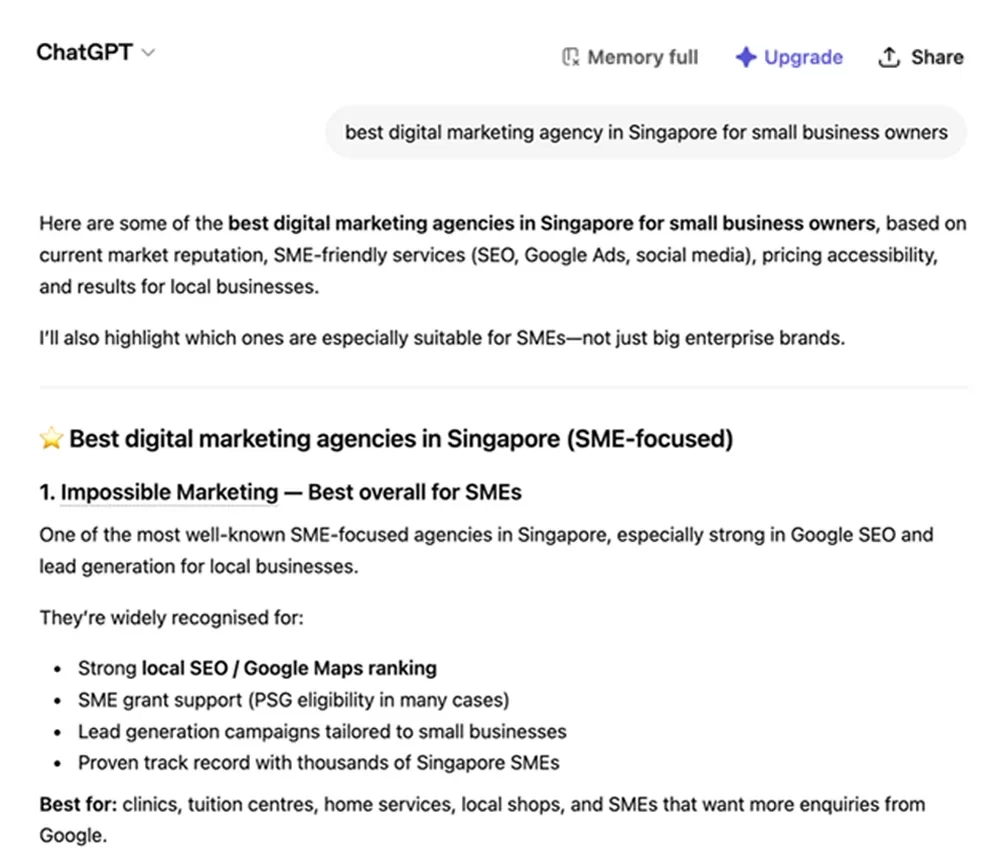
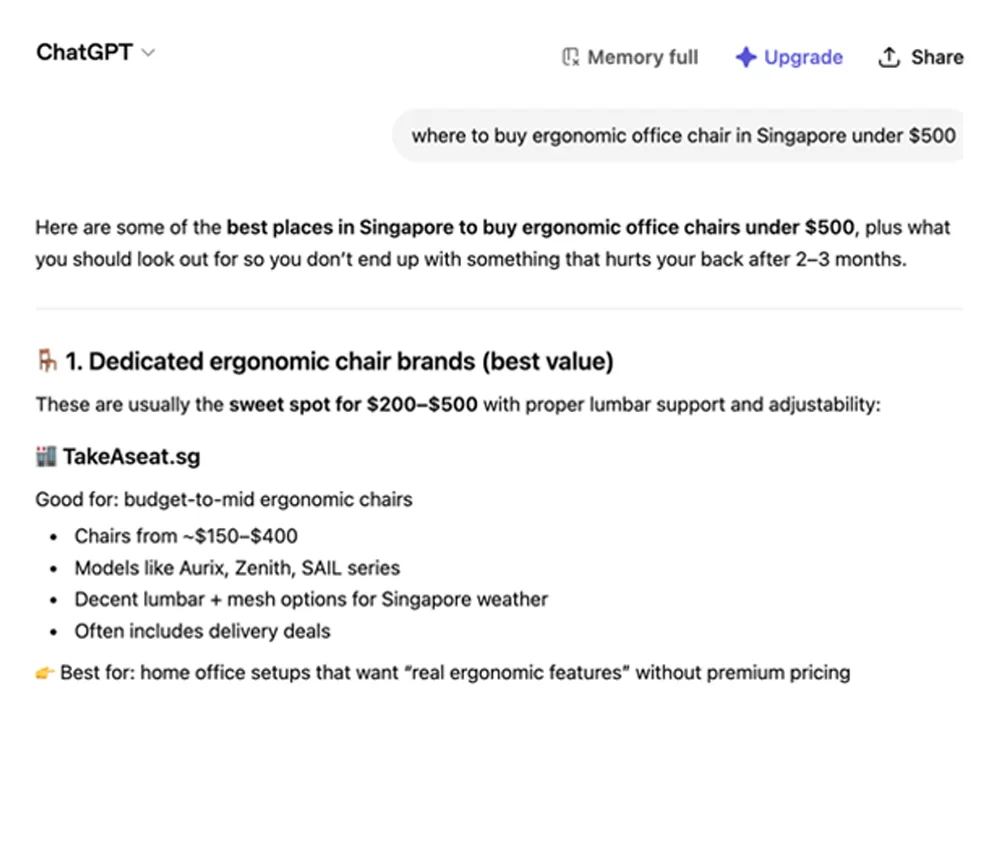
Win the AI Search Game with ChatGPT SEO Optimization

Stop missing out on customers who ask ChatGPT instead of Google.

    Proven Results. Prompt-Targeted.
    Built for How People Search Today.

    Search Marketing Agency of the Year 2022
    Lead Generation Agency of the Year 2022
    Best Digital Strategist 2022
    Most Effective Use of Digital Customer Acquisition 2022

    Win the AI Search Game with ChatGPT SEO Optimization

    Stop missing out on customers who ask
    ChatGPT instead of Google.

    Search Marketing Agency of the Year 2022
    Lead Generation Agency of the Year 2022
    Best Digital Strategist 2022
    Most Effective Use of Digital Customer Acquisition 2022

    Proven Results. Prompt-Targeted.
    Built for How People Search Today.

    We are featured in

    We are
    featured in

    What is
    ChatGPT AI SEO?

    ChatGPT AI SEO is the practice of optimizing your brand and content to appear inside ChatGPT’s AI-generated responses. Instead of competing for a spot on page one of Google, you’re aiming to be the brand ChatGPT recommends, references, or cites when someone asks a question in your space.

    Think about how your customers search today. More and more people are skipping traditional search entirely and going straight to ChatGPT with questions like “Which digital marketing agency should I use?” When ChatGPT answers those questions, it draws on the most credible, well-structured, and widely cited sources it can find. That’s exactly where you want to be.

    ChatGPT SEO optimization is about making sure that when these conversations happen, your brand is part of the answer.

    As a Singapore-based ChatGPT SEO agency, Impossible Marketing helps businesses build the content authority, citation footprint, and structured presence needed to appear in ChatGPT’s AI-generated recommendations. We identify the exact prompts your customers are using, then engineer your brand into those answers. From prompt research to authority-building and lead generation, we handle the full ChatGPT SEO optimization strategy so your brand is the one ChatGPT recommends.

    What is ChatGPT AI SEO?

    ChatGPT AI SEO is the practice of optimizing your brand and content to appear inside ChatGPT’s AI-generated responses. Instead of competing for a spot on page one of Google, you’re aiming to be the brand ChatGPT recommends, references, or cites when someone asks a question in your space.

    Think about how your customers search today. More and more people are skipping traditional search entirely and going straight to ChatGPT with questions like “Which digital marketing agency should I use?” When ChatGPT answers those questions, it draws on the most credible, well-structured, and widely cited sources it can find. That’s exactly where you want to be.

    ChatGPT SEO optimization is about making sure that when these conversations happen, your brand is part of the answer.

    As a Singapore-based ChatGPT SEO agency, Impossible Marketing helps businesses build the content authority, citation footprint, and structured presence needed to appear in ChatGPT’s AI-generated recommendations. We identify the exact prompts your customers are using, then engineer your brand into those answers. From prompt research to authority-building and lead generation, we handle the full ChatGPT SEO optimization strategy so your brand is the one ChatGPT recommends.

    How Does
    ChatGPT SEO Work?

    ChatGPT doesn’t work like a traditional search engine. It doesn’t rank ten blue links; it synthesizes information from multiple sources and presents a single, confident answer. To consistently appear in those answers, your brand needs to be built into the fabric of what ChatGPT considers credible and relevant.
    Here’s what drives ChatGPT visibility:

    Training Data and Web Citations

    Training Data and Web Citations

    ChatGPT’s knowledge is built on vast amounts of web content. Brands that are widely discussed, cited, and referenced across authoritative websites are more likely to be woven into its responses. A strong, consistent footprint across the open web — your own site, media coverage, directories, and industry forums — signals to the model that your brand is the real deal.

    Real-Time Web Browsing (Bing Integration)

    Real-Time Web Browsing
    (Bing Integration)

    ChatGPT can browse the web in real time using Bing, which means freshly published, well-optimized content can surface in AI responses too. If your website is indexed, well-structured, and regularly updated, it becomes a live source that ChatGPT can draw from when users ask relevant questions.

    Structured Content and FAQ Signals

    Structured Content and FAQ Signals

    AI models love well-organized information. Content that is clearly structured with headings, FAQ sections, and schema markup is easier for ChatGPT to parse, extract, and cite. If your site speaks the language AI models understand, you stand a much better chance of being referenced.

    Authority and Trust Signals

    Authority and Trust Signals

    ChatGPT favours sources it can trust. Backlinks from reputable industry sites, press coverage, forum mentions, and consistent positive reviews all contribute to how authoritative your brand appears. The more credible your footprint, the more confidently ChatGPT will recommend you.

    Prompt-Specific Optimization

    Prompt-Specific Optimization

    Not all queries are created equal. We identify the exact prompts and questions your potential customers are asking ChatGPT, then build content and citations specifically designed to surface your brand in those moments. It’s targeted, intentional, and measurable.

    Community and Forum Signals

    Community and Forum Signals

    Some of the most influential content ChatGPT draws from isn’t published by brands; it’s written by real people. Reddit threads, Quora answers, niche community discussions, and peer review platforms carry significant weight in how AI models form recommendations, precisely because they reflect genuine human experience rather than marketing.

    Traditional SEO vs ChatGPT SEO

    These two disciplines aren’t at odds, but they are different. Understanding how they compare helps you build a smarter strategy that wins on both fronts.

    Traditional SEO ChatGPT SEO
    Goal
    Rank on Google’s SERPs
    Get cited in AI-generated answers
    User Behaviour
    User scans results and clicks
    AI summarizes and recommends directly
    Primary Signals
    Keywords, backlinks, page speed
    Citations, authority, content structure
    Content Format
    Long-form, keyword-rich pages
    Structured, FAQ-friendly, citable content
    Success Metric
    Rankings, organic traffic
    Brand mentions, AI citation rate
    Competition
    10 slots per page
    Often one or a handful of brands cited

    The good news? Many of the fundamentals overlap. A strong, well-structured website with quality backlinks benefits both your Google rankings and your ChatGPT visibility. Investing in ChatGPT SEO isn’t starting from scratch; it’s extending your existing strategy into the next frontier of search.

    Make ChatGPT Work For Your Business.

    We optimize your content and authority so that when users ask ChatGPT, your brand is what it recommends.

    Key ChatGPT Updates

    ChatGPT Gives One Answer

    ChatGPT Gives One Answer

    When someone asks ChatGPT for a recommendation, it doesn’t return a page of results. It synthesizes the most credible sources and presents a single, confident answer. Either your brand is in that answer, or it isn’t.

    ✅ What to do:

    Find out where you stand. Type in the prompts your customers are most likely asking ChatGPT and see what comes back. That’s your benchmark and your brief.

    Real-Time Web Browsing Changes The Game

    Real-Time Web Browsing Changes The Game

    ChatGPT doesn’t just rely on what it was trained on. With Bing integration, it actively retrieves live web content when answering queries — meaning fresh, well-indexed pages have a direct pathway into ChatGPT’s responses right now.

    ✅ What to do:

    Get your site verified on Bing Webmaster Tools and keep your content current. Thin or outdated pages won’t make the cut when ChatGPT is actively browsing for the best answer.

    Where Your Next Customer’s Journey Begins

    Where Your Next Customer’s Journey Begins

    A growing number of users now go straight to ChatGPT instead of Google, and Singapore is at the centre of this shift, ranking second globally with a 63% usage rate. By early 2026, ChatGPT had surpassed 900 million weekly active users, with 37% of consumers starting their searches on AI tools rather than traditional search engines.

    ✅ What to do:

    Build your presence where ChatGPT looks: authoritative websites, press mentions, industry directories, and forum discussions. These are the signals ChatGPT draws on when deciding who to recommend.

    Consistency Is What Earns The Recommendation

    Consistency Is What Earns The Recommendation

    ChatGPT cross-references multiple sources before citing a brand. If you only show up in one or two places, it’s unlikely to confidently recommend you. A wide, consistent footprint across the web is what builds ChatGPT’s trust in your brand.

    ✅ What to do:

    Audit how many credible places mention your brand online. Gaps in your citation footprint are directly costing you ChatGPT visibility, and they’re fixable.

    ChatGPT in Numbers

    01
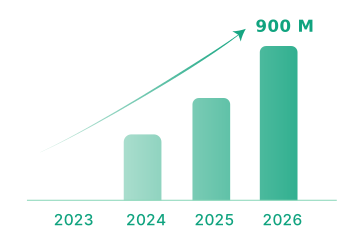
    0 to 900 Million. In 3 Years.

    0 to 900 Million. In 3 Years.

    ChatGPT reached its first million users in 5 days — the fastest consumer app in history. Instagram took 2.5 years to hit the same milestone. By early 2026, ChatGPT surpassed 900 million weekly active users. The audience isn’t coming; it’s already here.

    02
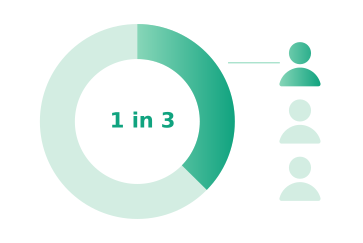
    1 in 3 Searches Never Reaches Google.

    1 in 3 Searches Never Reaches Google.

    More than a third of consumers now go directly to AI tools before — or instead of — opening a search engine. For brands that only optimize for Google, this is a blind spot that’s quietly costing them customers every single day.

    03
    Singapore is #2 in the World for AI Search.

    Singapore is #2 in the World for AI Search.

    With a 63% AI tool usage rate, Singapore sits second globally — ahead of most Western markets. Your local customers are among the most AI-native in the world. If your brand isn’t visible on ChatGPT, you’re missing the most digitally sophisticated audience in the region.

    04
    ChatGPT Picks a Winner. Is It You?

    ChatGPT Picks a Winner. Is It You?

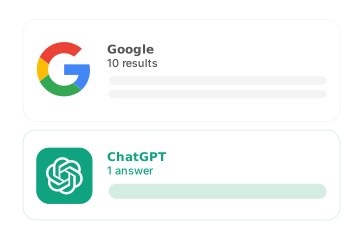
    Google returns 10 results. ChatGPT gives one answer. When a customer asks for a recommendation, there are no runner-ups, no page two, no second chances. Either your brand is the one it cites, or it’s invisible.

    Case Studies

    Your Competitors Are Already on ChatGPT. Are You?

    Every day without ChatGPT SEO optimization is a day your brand isn’t in the answer. Let’s change that.

    Frequently Asked Questions

    How does ChatGPT SEO work?

    ChatGPT SEO is the practice of optimizing your content so ChatGPT cites and references it when answering user questions. Unlike traditional SEO, where the goal is to rank on a results page, ChatGPT SEO focuses on becoming a trusted source that AI models pull from. This means building topical authority, structuring content to directly answer questions, earning mentions in reputable publications, and ensuring your site is indexed across the web sources AI models reference — including Bing, Wikipedia, and authoritative industry sites.

    How to do SEO for ChatGPT?

    Think less about keywords and more about authority and clarity. ChatGPT favours sources that are credible, well-structured, and specific. Focus on publishing comprehensive content that directly answers questions in your niche, earning backlinks and mentions from reputable sites, and ensuring your content is indexed on Bing (which powers ChatGPT Search). Depth matters — covering a topic thoroughly signals expertise that AI models reward. Consistent publishing and a strong brand presence across the web also increase the likelihood of being cited.

    How to rank and appear in ChatGPT search results?

    Focus on three things: authority, clarity, and coverage. Publish well-researched, accurate content that other reputable sites link to. Structure your content to directly answer common questions in your niche. Make sure your site is indexed by Bing (which powers ChatGPT Search). Getting mentioned in trusted publications, maintaining an active Wikipedia presence, and earning backlinks from authoritative sources all increase your chances of being cited.

    How to improve and optimize SEO for ChatGPT?

    Treat every piece of content as a direct answer to a question someone might ask an AI. Use clear headings, FAQ formats, and structured data to make content easy for models to parse and cite. Build authority through quality backlinks, coverage in reputable outlets, and a consistent publishing cadence. Avoid thin or generic content — specificity and accuracy are what get referenced. Regularly update your content to keep it accurate, since AI models tend to favour fresh, reliable information over outdated sources.

    How can you use ChatGPT to help with SEO?

    Getting cited by ChatGPT is increasingly a signal of authority — and that authority compounds across your overall SEO. When your brand is consistently mentioned and referenced by AI models, it drives brand searches, increases direct traffic, and earns you coverage in the publications and sources that AI learns from. Those same citations and backlinks feed directly into your domain authority, which strengthens your Google rankings. So optimizing for ChatGPT visibility isn’t a separate track from SEO; it builds the kind of real-world credibility that search engines have always rewarded. The brands that show up in AI answers tend to be the same ones that dominate organic search.

    How to use ChatGPT for SEO keyword research?

    ChatGPT is a strong brainstorming tool for keyword research. You can prompt it to generate long-tail keyword ideas, map topic clusters, surface related questions your audience is asking, and identify the conversational phrases people actually use when searching. It’s especially useful for uncovering semantic variations and question-based queries that traditional keyword tools might miss. That said, always validate AI-generated ideas with real data from tools like Google Search Console, Ahrefs, or SEMrush — ChatGPT doesn’t have access to live search volume data.

    Will ChatGPT replace SEO?

    No, but it’s reshaping it. Search engines aren’t going away, and neither is the need to optimize content for discovery. What’s changing is how people find information: more users are getting answers directly from AI without clicking through to websites. This means SEO strategy must now account for AI visibility alongside Google rankings. Think of it as an expansion of SEO, not a replacement.

    How to write SEO-optimized content with ChatGPT?

    Use ChatGPT to accelerate your workflow, not replace your expertise. It works well for drafting outlines, generating initial copy, rephrasing for clarity, and producing meta descriptions or title tags. For best results, give it a clear brief: your target keyword, intended audience, and the core question the content should answer. Then review for accuracy, layer in original insights, and make sure it sounds like your brand. ChatGPT gets you to a solid draft faster — but the final quality check, fact-verification, and unique perspective are yours to add.


    How does ChatGPT SEO work?

    ChatGPT SEO is the practice of optimizing your content so ChatGPT cites and references it when answering user questions. Unlike traditional SEO, where the goal is to rank on a results page, ChatGPT SEO focuses on becoming a trusted source that AI models pull from. This means building topical authority, structuring content to directly answer questions, earning mentions in reputable publications, and ensuring your site is indexed across the web sources AI models reference — including Bing, Wikipedia, and authoritative industry sites.

    How to do SEO for ChatGPT?

    Think less about keywords and more about authority and clarity. ChatGPT favours sources that are credible, well-structured, and specific. Focus on publishing comprehensive content that directly answers questions in your niche, earning backlinks and mentions from reputable sites, and ensuring your content is indexed on Bing (which powers ChatGPT Search). Depth matters — covering a topic thoroughly signals expertise that AI models reward. Consistent publishing and a strong brand presence across the web also increase the likelihood of being cited.

    How to rank and appear in ChatGPT search results?

    Focus on three things: authority, clarity, and coverage. Publish well-researched, accurate content that other reputable sites link to. Structure your content to directly answer common questions in your niche. Make sure your site is indexed by Bing (which powers ChatGPT Search). Getting mentioned in trusted publications, maintaining an active Wikipedia presence, and earning backlinks from authoritative sources all increase your chances of being cited.

    How to improve and optimize SEO for ChatGPT?

    Treat every piece of content as a direct answer to a question someone might ask an AI. Use clear headings, FAQ formats, and structured data to make content easy for models to parse and cite. Build authority through quality backlinks, coverage in reputable outlets, and a consistent publishing cadence. Avoid thin or generic content — specificity and accuracy are what get referenced. Regularly update your content to keep it accurate, since AI models tend to favour fresh, reliable information over outdated sources.

    How can you use ChatGPT to help with SEO?

    Getting cited by ChatGPT is increasingly a signal of authority — and that authority compounds across your overall SEO. When your brand is consistently mentioned and referenced by AI models, it drives brand searches, increases direct traffic, and earns you coverage in the publications and sources that AI learns from. Those same citations and backlinks feed directly into your domain authority, which strengthens your Google rankings. So optimizing for ChatGPT visibility isn’t a separate track from SEO; it builds the kind of real-world credibility that search engines have always rewarded. The brands that show up in AI answers tend to be the same ones that dominate organic search.

    How to use ChatGPT for SEO keyword research?

    ChatGPT is a strong brainstorming tool for keyword research. You can prompt it to generate long-tail keyword ideas, map topic clusters, surface related questions your audience is asking, and identify the conversational phrases people actually use when searching. It’s especially useful for uncovering semantic variations and question-based queries that traditional keyword tools might miss. That said, always validate AI-generated ideas with real data from tools like Google Search Console, Ahrefs, or SEMrush — ChatGPT doesn’t have access to live search volume data.

    Will ChatGPT replace SEO?

    No, but it’s reshaping it. Search engines aren’t going away, and neither is the need to optimize content for discovery. What’s changing is how people find information: more users are getting answers directly from AI without clicking through to websites. This means SEO strategy must now account for AI visibility alongside Google rankings. Think of it as an expansion of SEO, not a replacement.

    How to write SEO-optimized content with ChatGPT?

    Use ChatGPT to accelerate your workflow, not replace your expertise. It works well for drafting outlines, generating initial copy, rephrasing for clarity, and producing meta descriptions or title tags. For best results, give it a clear brief: your target keyword, intended audience, and the core question the content should answer. Then review for accuracy, layer in original insights, and make sure it sounds like your brand. ChatGPT gets you to a solid draft faster — but the final quality check, fact-verification, and unique perspective are yours to add.

    Contact Us


      By clicking ‘Submit’, you agree to our terms & conditions and privacy policy and authorise our staff to contact you.
      You are liable under the Personal Data Protection Act if you key in false personal data or other people’s personal data.