











Perplexity is not a search engine. It’s an answer engine. When someone asks Perplexity a question, it doesn’t return a page of links for them to sift through. It synthesizes information from across the web into a direct, well-sourced answer, and it shows exactly which sources it drew from. Perplexity AI SEO is the practice of making your brand one of those cited sources.
What makes Perplexity uniquely valuable for brands is its transparency. Every response comes with numbered citations that users can see, click, and verify. Being cited in a Perplexity answer isn’t just AI visibility in the background. Your brand appears as a visible, attributed source alongside the response itself.
Perplexity’s user base skews heavily towards researchers, professionals, and high-intent individuals who are actively looking for reliable information before making a decision. Getting in front of these users, in the format they trust most, is exactly what Perplexity SEO is designed to achieve.
Impossible Marketing is an agency that specializes in getting brands cited as named, visible sources in Perplexity’s answers. We build the domain authority, content quality, and citation breadth that Perplexity’s source-selection process requires. The result is your brand appearing as a trusted, attributed reference in front of Perplexity’s research-driven, high-intent audience — exactly when they’re ready to decide.
Perplexity is not a search engine. It’s an answer engine. When someone asks Perplexity a question, it doesn’t return a page of links for them to sift through. It synthesizes information from across the web into a direct, well-sourced answer, and it shows exactly which sources it drew from. Perplexity AI SEO is the practice of making your brand one of those cited sources.
What makes Perplexity uniquely valuable for brands is its transparency. Every response comes with numbered citations that users can see, click, and verify. Being cited in a Perplexity answer isn’t just AI visibility in the background. Your brand appears as a visible, attributed source alongside the response itself.
Perplexity’s user base skews heavily towards researchers, professionals, and high-intent individuals who are actively looking for reliable information before making a decision. Getting in front of these users, in the format they trust most, is exactly what Perplexity SEO is designed to achieve.
Impossible Marketing is an agency that specializes in getting brands cited as named, visible sources in Perplexity’s answers. We build the domain authority, content quality, and citation breadth that Perplexity’s source-selection process requires. The result is your brand appearing as a trusted, attributed reference in front of Perplexity’s research-driven, high-intent audience — exactly when they’re ready to decide.
Perplexity draws from multiple data sources when constructing its answers.
Here’s what determines whether your brand makes it in:

Perplexity actively crawls and indexes the web in real time, which means fresh, well-structured, and credible content can surface in its answers almost immediately. Unlike platforms that rely solely on training data, Perplexity is always looking at what’s current, making content freshness a meaningful competitive advantage.

Perplexity is unusually transparent about where it sources its answers. It selects a small number of credible references and displays them as numbered citations alongside every response. Getting selected as one of those sources requires meeting a clear bar of authority, relevance, and content quality. Once you’re there, your brand is visible to every user who reads that answer.

Perplexity gravitates towards sources it deems reliable. Established domain authority, high-quality backlinks, consistent publishing, and a strong presence across trusted third-party platforms all signal to Perplexity that your site is worth citing. Low-authority or inconsistently maintained sites rarely make the cut.

Perplexity values content that answers questions directly and concisely. Given that its entire model is built around delivering clear answers, it naturally favours sources that are well-organized, factually precise, and easy to extract useful information from. Content structured around common questions in your category is particularly well-suited to Perplexity citation.

We identify the exact queries your potential customers are typing into Perplexity, then build the content, authority signals, and citation infrastructure specifically designed to surface your brand in those responses. Every part of the strategy is mapped back to the prompts that matter most to your business.

Perplexity actively indexes community platforms — YouTube, Reddit threads, Quora answers, and niche forums — as first-class sources alongside traditional websites. Brands that are genuinely discussed and recommended in these spaces have a source advantage that purely editorial content can’t replicate, making organic community presence a meaningful part of any Perplexity visibility strategy.
Perplexity SEO operates on a fundamentally different model from traditional search.
Here’s how they compare:
| Traditional SEO | Perplexity SEO | |
|---|---|---|
|
Goal |
Rank on search engine results pages |
Be a cited source in Perplexity’s answers |
|
How Results Appear |
Ranked links the user clicks through |
Numbered citations visible alongside the AI answer |
|
Primary Signals |
Keywords, backlinks, technical SEO |
Authority, content clarity, citation breadth |
|
User Intent |
Varies from browsing to high intent |
Research-focused, high-intent, decision-ready |
|
Content Format |
Keyword-optimized long-form content |
Direct, well-sourced, question-answering content |
|
Brand Visibility |
Brand visible if user clicks your link |
Brand visible as a named, attributed citation |
The key distinction is visibility. In traditional SEO, your brand only gets noticed if a user clicks your link. In Perplexity, your brand appears as a cited source whether or not the user clicks through. That passive brand exposure, to a high-intent research audience, is a form of visibility that traditional search simply cannot offer.
When users ask Perplexity for recommendations, insights, and solutions, make sure your business is part of the responses.

Most AI platforms weave citations into their answers invisibly. Perplexity does the opposite. Every response comes with numbered, clickable citations displayed prominently alongside the answer. This means being cited in Perplexity isn’t just a background signal. It’s a named, visible brand attribution that every user reading that response can see.
✅ What to do:
Search for your category on Perplexity and look at which brands are being cited. Those are the sources Perplexity currently trusts. Understanding why they’re there and where you fall short is the starting point for your Perplexity SEO strategy.

Perplexity users are not idly scrolling. They are actively researching, comparing options, and looking for reliable information to inform a decision. This is a consistently high-intent audience, and the brands they encounter during that research phase carry disproportionate weight in the final decision. A Perplexity citation puts your brand in the room at exactly the right moment.
✅ What to do:
Think about the questions your customers ask before they are ready to buy, not just when they are. Build content that answers those research-stage questions clearly and authoritatively, and you position your brand as the natural choice before the decision is even made.

Because Perplexity searches the web in real time, recently published content can surface in answers much faster than it would climb Google’s rankings. Brands that publish consistently and keep their content current have a structural advantage over those sitting on static, dated pages. In a fast-moving category, this can be the difference between being cited and being invisible.
✅ What to do:
Build a consistent publishing cadence. Regular updates to key pages, fresh responses to emerging questions in your category, and timely commentary on industry developments all give Perplexity more current content to draw from when constructing answers.

Perplexity typically cites only three to five sources per answer — far fewer than the ten links Google returns. That concentration makes each citation genuinely differentiating, but it also means a weak authority footprint will almost always lose out to a stronger one. With 780 million queries processed in May 2025 alone and a user base that crossed 45 million by mid-2025, the competition for those spots is only growing.
✅ What to do:
Prioritize quality over quantity in your authority-building. A smaller number of high-quality citations from genuinely reputable sources will do more for your Perplexity visibility than a large volume of low-quality links. Perplexity is selecting the best, not the most.

Perplexity doesn’t limit itself to standard web pages. It can draw from news sources, academic content, forums, and other web-indexed material when constructing answers. This gives brands more ways to appear as a cited source, and means that a well-rounded content and PR strategy, one that puts your brand across multiple content formats and channels, significantly increases your chances of being picked up.
✅ What to do:
Diversify where your brand appears across the web. Press coverage, industry articles, forum mentions, and well-structured blog content all contribute to the varied footprint that Perplexity draws from. A brand that only exists on its own website is leaving a lot of Perplexity visibility on the table.

Every Perplexity response generates a set of suggested follow-up questions displayed directly below the answer. As users continue their research by clicking through these related queries, they move deeper into a topic — and brands that appear consistently across multiple related questions accumulate far more exposure than a single citation delivers.
✅ What to do:
Map out the cluster of questions surrounding your core category, not just the primary search terms. When you build content that addresses the broader research journey, you increase the likelihood of appearing at multiple points in a single user’s session, not just one.

In May 2025 alone, Perplexity processed 780 million queries. These aren’t casual searches — they’re deliberate, research-driven questions from users actively seeking reliable answers. Every one of those queries is a moment where a brand either gets cited, or doesn’t exist.
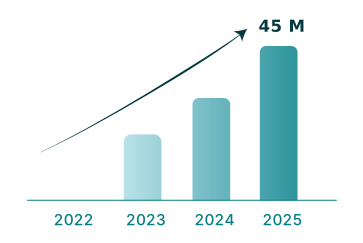
Perplexity’s user base crossed 45 million by mid-2025, built almost entirely on word-of-mouth among professionals, researchers, and high-intent decision-makers. This audience didn’t stumble onto Perplexity. They chose it specifically because they want answers they can trust.
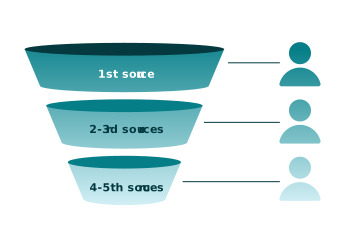
Perplexity typically cites just 3 to 5 sources per answer. Not 10 results. Not a full page. Three to five brands — and then the answer ends. The concentration makes each citation genuinely valuable, and makes the gap between being cited and being invisible completely binary.
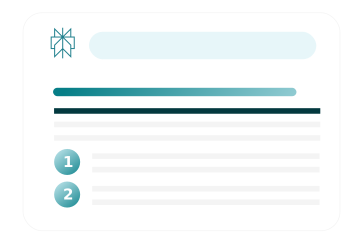
In traditional SEO, your brand only appears if the user clicks your link. In Perplexity, your brand is shown as a named, numbered citation alongside every answer — visible to every user who reads it, whether they click through or not. It’s a form of brand exposure that search rankings can’t replicate.
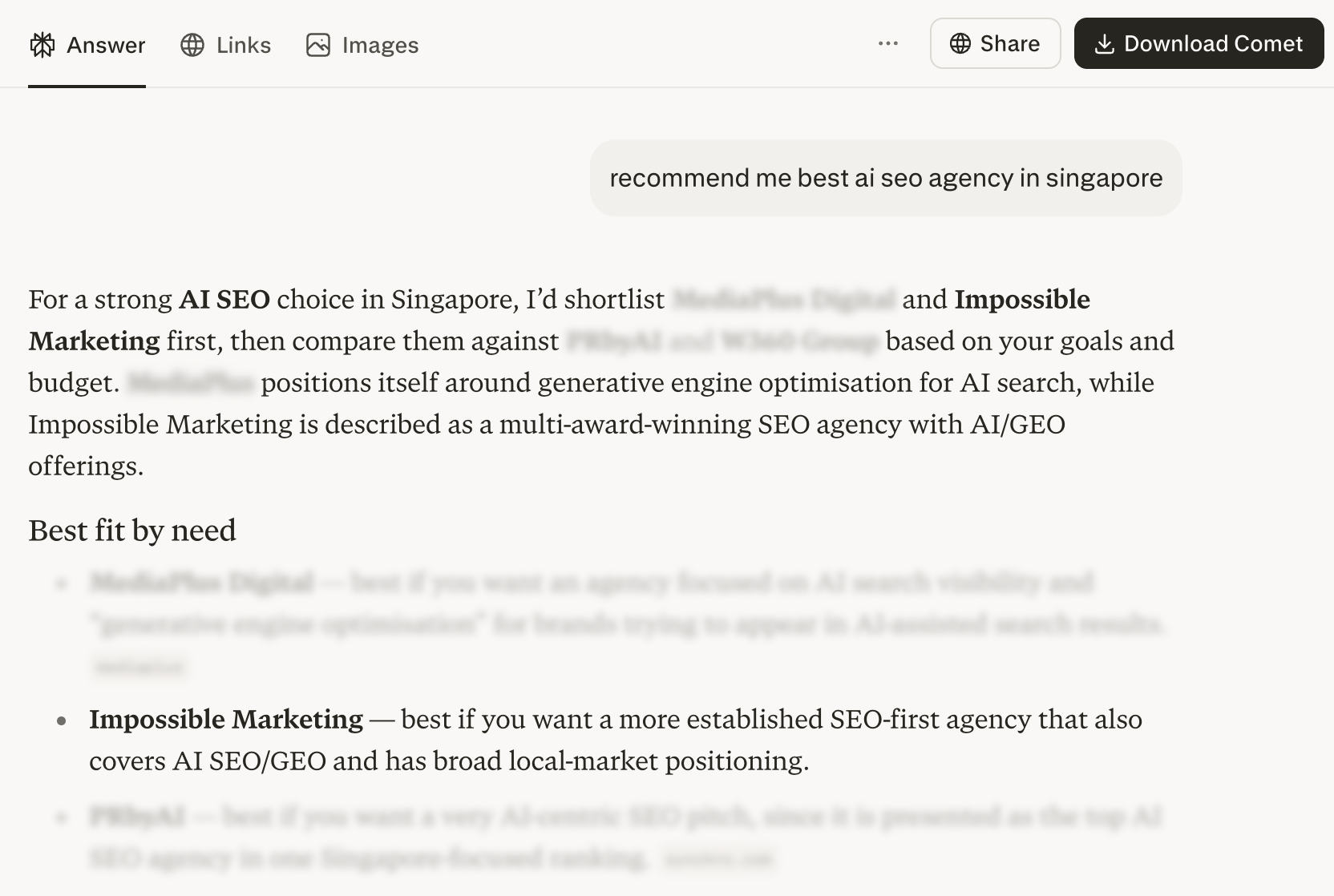
We put Perplexity SEO to the test on ourselves, and the results spoke for themselves. Through source optimisation, structured content, and a systematic strategy tailored to how Perplexity pulls and cites real-time references, we achieved an average mention rate of over 66% across Perplexity, ChatGPT, Google AI Overviews, Gemini, and Claude, racking up 100 brand mentions across major AI platforms and establishing Impossible Marketing as one of the most AI-visible digital marketing agencies in Singapore.
We put Perplexity SEO to the test on ourselves, and the results spoke for themselves. Through source optimisation, structured content, and a systematic strategy tailored to how Perplexity pulls and cites real-time references, we achieved an average mention rate of over 66% across Perplexity, ChatGPT, Google AI Overviews, Gemini, and Claude, racking up 100 brand mentions across major AI platforms and establishing Impossible Marketing as one of the most AI-visible digital marketing agencies in Singapore.
Perplexity users skip Google entirely. Perplexity SEO optimization ensures your brand is what they find.
The most effective way to approach Perplexity for SEO is to study what it cites. Search for questions in your niche on Perplexity and pay close attention to which brands and sources get referenced, how answers are structured, and what kinds of content earn a citation link. Use that as a benchmark to audit your own content — are you answering questions directly enough? Is your site authoritative enough to be considered a trusted source? Perplexity pulls from live web results, which means your content needs to be both well-indexed and credible enough to surface. Optimizing for Perplexity citation sharpens your content quality across the board, benefiting your visibility on every AI platform and in traditional search.
Perplexity is changing how a segment of users — particularly researchers, professionals, and tech-savvy audiences — consume information online. Instead of clicking through multiple search results, they get a synthesized answer with cited sources directly on the page. For brands, this shifts the value from ranking to being cited. If your brand isn’t one of the sources Perplexity references, you’re invisible to that user regardless of your Google ranking. At the same time, brands that do get cited gain significant credibility — Perplexity’s citation links drive referral traffic from high-intent users who are already engaged with the topic. As Perplexity’s user base grows, its impact on how traffic flows from search will only increase.
They serve different use cases, and for SEO purposes what matters most is where your target audience is turning for answers. Perplexity is designed specifically as a search and research tool — it pulls from live web results and always cites its sources, making it popular with users doing active research. ChatGPT is a broader AI assistant that handles everything from writing to analysis, with web search as one feature among many. For SEO citation potential, Perplexity is particularly valuable because every answer includes visible source links, meaning a citation directly drives traffic and brand visibility. That said, both platforms are worth optimizing for — the content practices that earn citations on Perplexity overlap heavily with what works on ChatGPT, Gemini, and Claude.
Perplexity pulls from live web search results, which means your path to appearing in its answers runs directly through your existing SEO foundation. Your content needs to be well-indexed, ranking for relevant queries, and coming from a domain with strong authority signals. Beyond that, structure matters — Perplexity favors content that answers questions directly and clearly, so use concise headings, get to the point quickly, and avoid burying your key answers in dense paragraphs. Earning backlinks and mentions from reputable sources also increases the likelihood of being picked up as a citation. Fresh, regularly updated content has an advantage too, since Perplexity draws from current web results rather than a static training dataset. Think of it as the intersection of strong traditional SEO and GEO best practices — you need both to consistently earn the citation.
No, but it’s adding a new dimension to it. Perplexity isn’t replacing the need to create authoritative, well-structured content — if anything, it raises the bar for what content needs to be in order to earn a citation. What’s shifting is how a growing segment of users discover information: instead of scanning search results and clicking through, they get a synthesized answer with sources cited inline. For brands, this means visibility now has two components — ranking in traditional search and being cited in AI-generated answers. The practices that earn Perplexity citations are the same ones that strengthen your SEO: quality content, strong backlinks, and genuine topical authority. Optimizing for Perplexity doesn’t pull focus from SEO. It makes your SEO sharper.
Perplexity is a surprisingly powerful tool for uncovering the questions your audience is actually asking. Because it’s designed as a research and discovery tool, the queries people type into Perplexity tend to be more conversational and intent-driven than traditional keyword searches — which gives you a direct window into how your audience naturally phrases their questions. Use it to explore topics in your niche and pay attention to the follow-up questions it surfaces, the related queries it suggests, and the language patterns it uses in answers. These are signals of real user intent that you can translate into content topics and long-tail keywords. Cross-reference what you find with traditional keyword tools for search volume data, and you have a strong foundation for content that performs in both AI search and traditional SEO.
The most effective way to approach Perplexity for SEO is to study what it cites. Search for questions in your niche on Perplexity and pay close attention to which brands and sources get referenced, how answers are structured, and what kinds of content earn a citation link. Use that as a benchmark to audit your own content — are you answering questions directly enough? Is your site authoritative enough to be considered a trusted source? Perplexity pulls from live web results, which means your content needs to be both well-indexed and credible enough to surface. Optimizing for Perplexity citation sharpens your content quality across the board, benefiting your visibility on every AI platform and in traditional search.
Perplexity is changing how a segment of users — particularly researchers, professionals, and tech-savvy audiences — consume information online. Instead of clicking through multiple search results, they get a synthesized answer with cited sources directly on the page. For brands, this shifts the value from ranking to being cited. If your brand isn’t one of the sources Perplexity references, you’re invisible to that user regardless of your Google ranking. At the same time, brands that do get cited gain significant credibility — Perplexity’s citation links drive referral traffic from high-intent users who are already engaged with the topic. As Perplexity’s user base grows, its impact on how traffic flows from search will only increase.
They serve different use cases, and for SEO purposes what matters most is where your target audience is turning for answers. Perplexity is designed specifically as a search and research tool — it pulls from live web results and always cites its sources, making it popular with users doing active research. ChatGPT is a broader AI assistant that handles everything from writing to analysis, with web search as one feature among many. For SEO citation potential, Perplexity is particularly valuable because every answer includes visible source links, meaning a citation directly drives traffic and brand visibility. That said, both platforms are worth optimizing for — the content practices that earn citations on Perplexity overlap heavily with what works on ChatGPT, Gemini, and Claude.
Perplexity pulls from live web search results, which means your path to appearing in its answers runs directly through your existing SEO foundation. Your content needs to be well-indexed, ranking for relevant queries, and coming from a domain with strong authority signals. Beyond that, structure matters — Perplexity favors content that answers questions directly and clearly, so use concise headings, get to the point quickly, and avoid burying your key answers in dense paragraphs. Earning backlinks and mentions from reputable sources also increases the likelihood of being picked up as a citation. Fresh, regularly updated content has an advantage too, since Perplexity draws from current web results rather than a static training dataset. Think of it as the intersection of strong traditional SEO and GEO best practices — you need both to consistently earn the citation.
No, but it’s adding a new dimension to it. Perplexity isn’t replacing the need to create authoritative, well-structured content — if anything, it raises the bar for what content needs to be in order to earn a citation. What’s shifting is how a growing segment of users discover information: instead of scanning search results and clicking through, they get a synthesized answer with sources cited inline. For brands, this means visibility now has two components — ranking in traditional search and being cited in AI-generated answers. The practices that earn Perplexity citations are the same ones that strengthen your SEO: quality content, strong backlinks, and genuine topical authority. Optimizing for Perplexity doesn’t pull focus from SEO. It makes your SEO sharper.
Perplexity is a surprisingly powerful tool for uncovering the questions your audience is actually asking. Because it’s designed as a research and discovery tool, the queries people type into Perplexity tend to be more conversational and intent-driven than traditional keyword searches — which gives you a direct window into how your audience naturally phrases their questions. Use it to explore topics in your niche and pay attention to the follow-up questions it surfaces, the related queries it suggests, and the language patterns it uses in answers. These are signals of real user intent that you can translate into content topics and long-tail keywords. Cross-reference what you find with traditional keyword tools for search volume data, and you have a strong foundation for content that performs in both AI search and traditional SEO.