
We’ve Filed a Police Report Over “Jen Koh” Google Review
Posted on: July 10, 2026
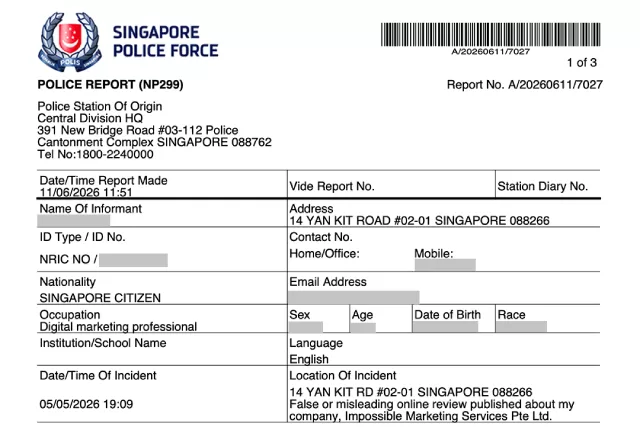
Over the past 15 years, Impossible Marketing has served more than 2,000 businesses and earned over 700 positive reviews. This is the first time we have received a negative review relating to our SEO services. As the owner of the company, I believe it is only fair that I share the full sequence of events so that our clients and prospective clients can understand what happened and draw their own conclusions.
Throughout this article, I will refer to the reviewer as “Jen Koh” and use the pronouns they/them, as we are unable to confirm the individual’s gender.
How It All Started
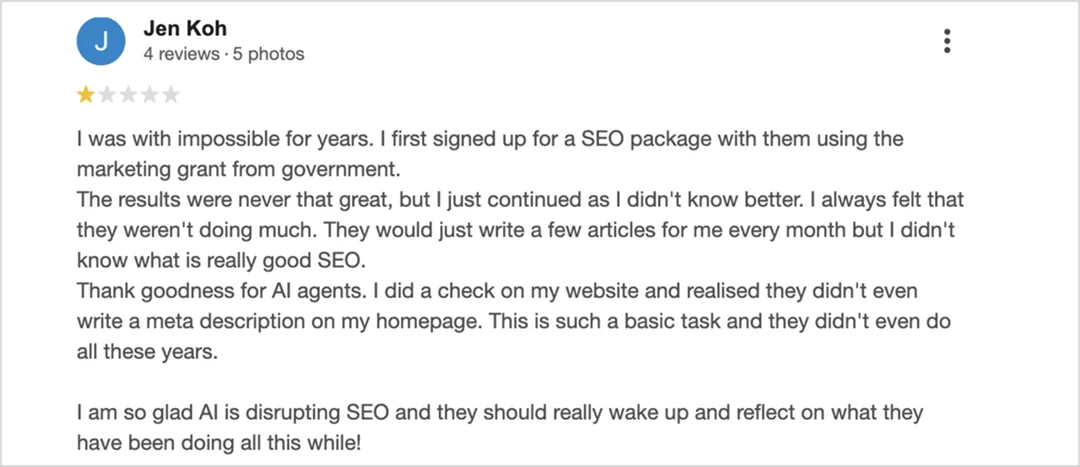
On 5 May 2026, I received a notification from Google that our Google Business Profile had received a new review.
Receiving reviews is nothing unusual. However, this one caught my attention because it was our first 1-star review relating to our SEO services.
The review was posted by someone using the name “Jen Koh.”
“Jen Koh” Not Found In Our CRM
I immediately called a meeting with my team to investigate the matter. We searched our CRM system but could not find any client by the name of “Jen Koh.”
To be thorough, we also checked variations such as Jenny Koh, Jennifer Koh, and other similar names. Despite these efforts, we found no matching client records.
As we were unable to verify the identity behind the account, I replied publicly, inviting “Jen Koh” to contact us directly so we could look into the matter.
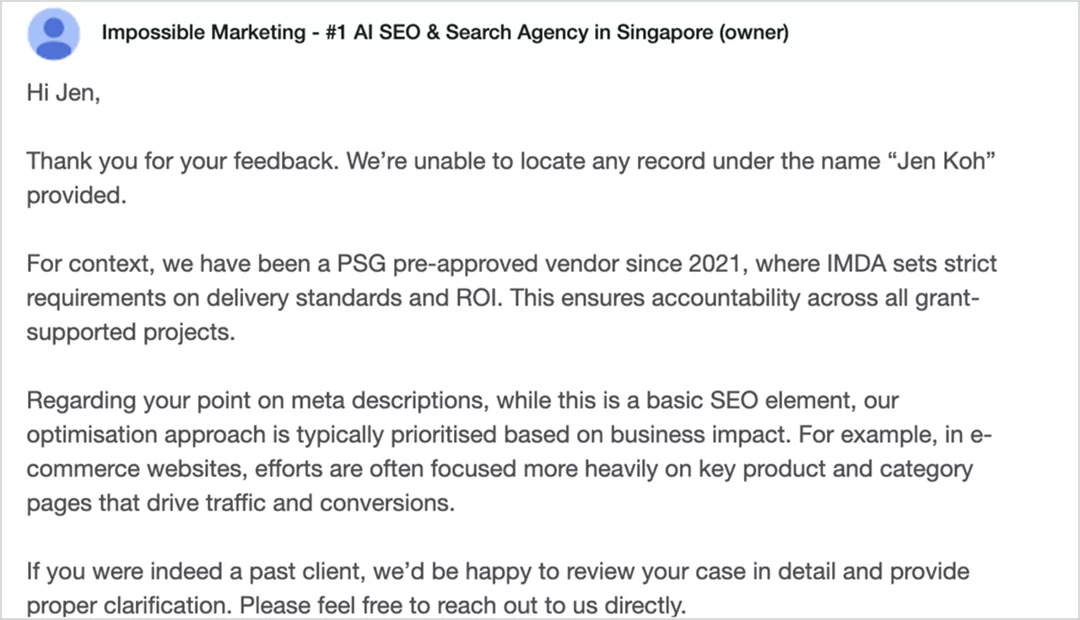
I was hoping that the person behind the account using the name “Jen Koh” would provide us with more details so that we could understand what had led to such dissatisfaction.
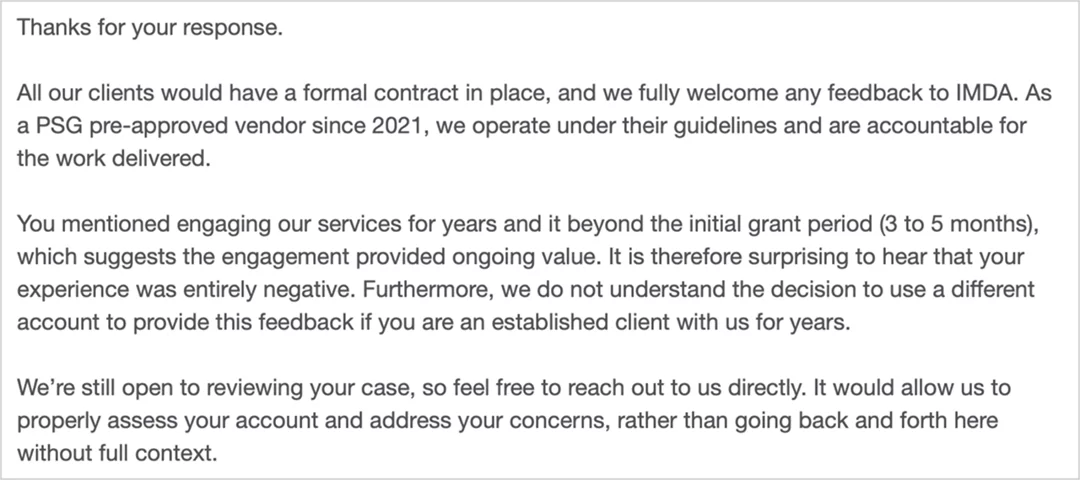
A few days later, the review was updated with the additional response:

The response raised more questions than it answered.
Many people, myself included, have multiple email accounts for personal, business, and other purposes. However, using a different email account is very different from using a completely different name.
I could not understand why the reviewer had initially identified themself as “Jen Koh”, then later claimed to have been our customer under another name. Without knowing the details, we had no way to verify the identity behind the reviewer and retrieve the campaign to check.
One point also stood out to me: in the original review, the reviewer stated that they had been with our company for years. If true, that would suggest we had done something right for “Jen Koh” to have remained with us for such a long period.
That was exactly why I wanted to speak with the reviewer. If a long-term client had become dissatisfied, I wanted to understand what had changed, investigate the concerns thoroughly, and, if necessary, learn from the experience and make things right.
I therefore replied again, inviting the reviewer to contact us directly and provide sufficient information for us to retrieve the campaign details.
Verification with IMDA
In the meantime, the reviewer had stated that a complaint will be lodged against our company with the Infocomm Media Development Authority (IMDA), so I reached out to IMDA directly.
Given the seriousness of the allegations, my team and I monitored the matter closely over the following month and checked in with IMDA on multiple occasions.
After approximately one month, IMDA confirmed that no complaint had been lodged against our company.
Filing a Police Report
At this stage, we had:
- Been unable to verify the identity of “Jen Koh”
- Received no information that would allow us to identify the client relationship.
- Confirmed with IMDA that no complaint had been lodged, despite the earlier statement that one will be.
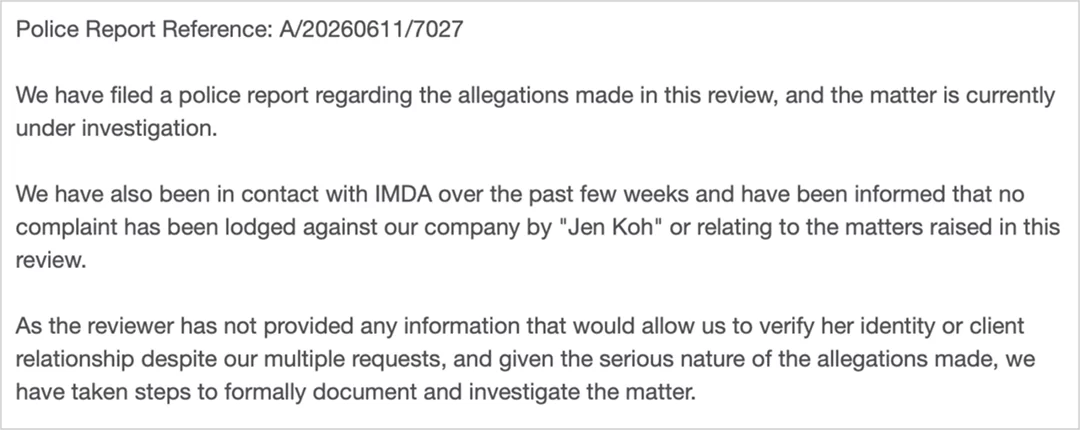
Given these circumstances, I made the decision to formally document the matter by filing a police report on 11 June 2026.
The Review Was Updated Again
“Jen Koh” subsequently updated the review again.
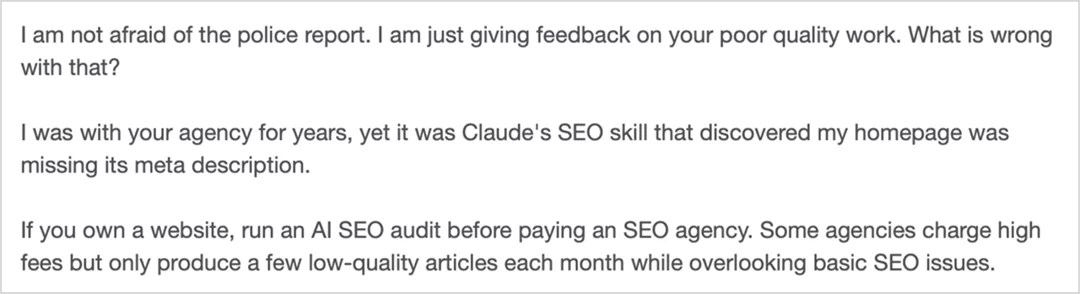
This time, the review went beyond describing a personal experience. It also encouraged readers to conduct an AI SEO audit before engaging an SEO agency, and suggested that some agencies charge high fees while producing only a few low-quality articles and overlooking basic SEO issues. While these comments read as general observations about SEO agencies, the fact that the review was posted on our Google Business Profile makes it appear directed at our agency, making it look like an attempt at tarnishing our reputation and discouraging potential customers from engaging us.
Reading through the whole review, I found that many of the statements did not accurately reflect the work we had delivered or how our SEO campaigns are managed.
Rather than continue an ongoing exchange through Google reviews, I decided it would be more helpful to address each claim individually, supported by evidence and examples, so that readers can better understand our SEO process.
Claim #1: Just Writes a Few Articles Every Month
Since the reviewer mentioned that they have taken up a marketing grant, here is how our actual process is:
- Digital Marketing Strategy Report – Before a campaign starts, we identify gaps and recommend keywords opportunities specific to the client’s site.
- Onboarding Call – Once the campaign begins, our Client Success Manager gets on a call to understand the client’s business and goals.
- Website Analysis – We assess the site’s structure and how SEO signals flow through it.
- Technical SEO – We resolve Core Web Vitals issues, improve site speed, and use Google Search Console access to identify existing traffic.
- On-page SEO – We map each targeted page to the right keyword intent, then optimise these pages. This includes meta titles, meta descriptions, headers, internal and external links, web structure, image optimisation and more.
- Off-page SEO – We build relevant, quality backlinks with reputable sites in the client’s industry, focusing on authority and relevance over volume to strengthen the site’s overall domain trust.
- Blog Content – Regular blog updates help reinforce Google’s freshness signal, close keyword gaps, and drive additional traffic.
- Monthly Reporting – We provide monthly reports covering keyword ranking and recommendations to further improve the campaign for the following month.
- Campaign Reviews – We also hold review calls every 3 to 6 months to walk through performance against goals, listen to client feedback, discuss any shifts in business priorities, and adjust the strategy accordingly.
- Final Report – An 80-page comprehensive report covering the full campaign: strategy execution, technical and on/off-page work completed, content published, traffic and ranking outcomes, and a clear focus on ensuring a positive ROAS (Return on Ad Spend) for the client.
Our processes are closely monitored by IMDA, as this is a mandatory requirement for all grant clients. Failing to do so could result in the removal of our pre-approved vendor licence by IMDA.
Claim #2: Missing Meta Descriptions
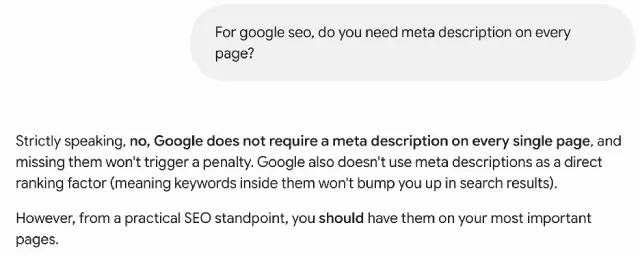
Without visibility into the exact website, it’s difficult to assess this fairly. That said, it’s worth noting what Google’s own guidance says on the matter: meta descriptions are primarily necessary for the key pages you actually want to rank — not every page on a site.
Take a hypothetical site with over 100 pages, including:
- www.example.com/iphone
- www.example.com/ipad
- www.example.com/macbook
- www.example.com/cable
- www.example.com/terms
The iPhone, iPad, and MacBook pages are the biggest drivers of business value. It makes sense that these were prioritised over the rest of the catalogue. A page like /cable may still get traffic, but it doesn’t contribute much to the client’s commercial goals. So it’s reasonable that it got less attention. This follows a well-known SEO principle: a small number of pages usually drive most of a site’s traffic and value. Effort is best focused there, rather than spread evenly across every page.
Claim #3: Claude “Discovered” the Missing Meta Description
Addressing this claim requires understanding how AI models work. Ask an AI a question, and it’s built to always produce an answer, never “no further improvements needed.” Ask what the world’s most delicious food is, and it names one. Ask what’s more delicious than that, and it finds something. Ask again, and it keeps going. There’s no natural stopping point, because generating a response is the model’s core function, not a verdict on whether the previous answer was wrong.
SEO audits work the same way. Every agency operates on its own strategy, and so does every SEO approach. Each agency makes its own defensible calls: one page targeting three keywords versus three pages each targeting one, long-tail versus short-tail focus, how deep a URL structure should go, and so on. When Claude’s take differs from an agency’s approach, that gap doesn’t mean the agency dropped the ball. It means two reasonable strategies diverge, the same way two great chefs can disagree on the best way to cook a steak.
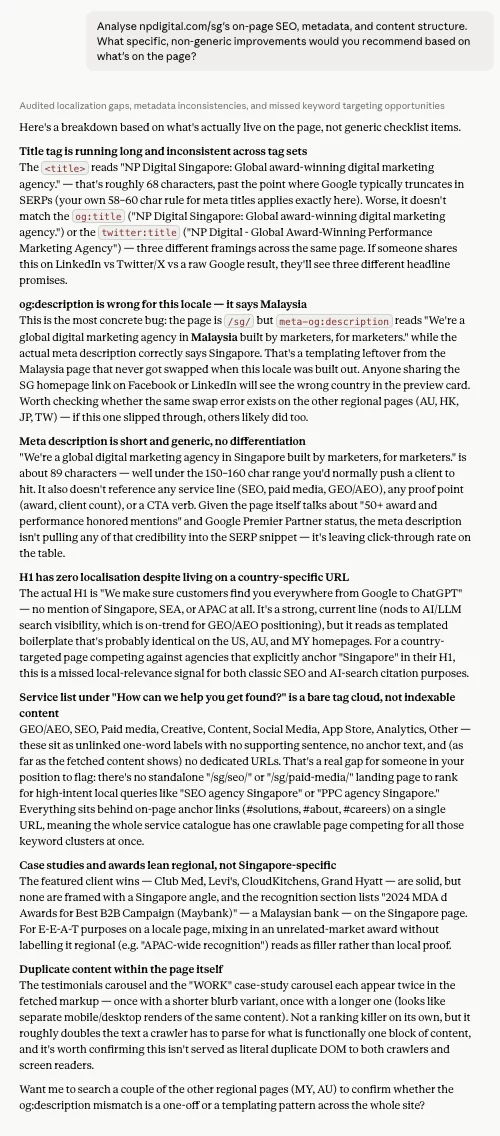
Take Neil Patel, widely regarded as one of the best SEO marketers in the world, and his agency’s Singapore site, npdigital.com/sg. Run it past Claude and you’ll get a list of recommendations, same as any other site, because that’s what the model is built to do regardless of how well-optimised the site already is. Claude will flag details every time, not because NP Digital’s SEO is lacking, but because the model is designed to keep finding something to say. The same logic applies to any audit result: a list of “improvements” reflects how the AI operates, not necessarily a verdict on the agency’s competence.
The same logic applies to DBS’s website. Its homepage carries a solid, well-written meta description, but a closer look at the raw metadata still turns up something an AI would flag as a gap or inconsistency. That doesn’t mean DBS’s marketing team is falling short, as a bank with DBS’s resources clearly has SEO covered. It simply means there’s always one more item an AI can add to the list, regardless of how solid the underlying strategy already is.
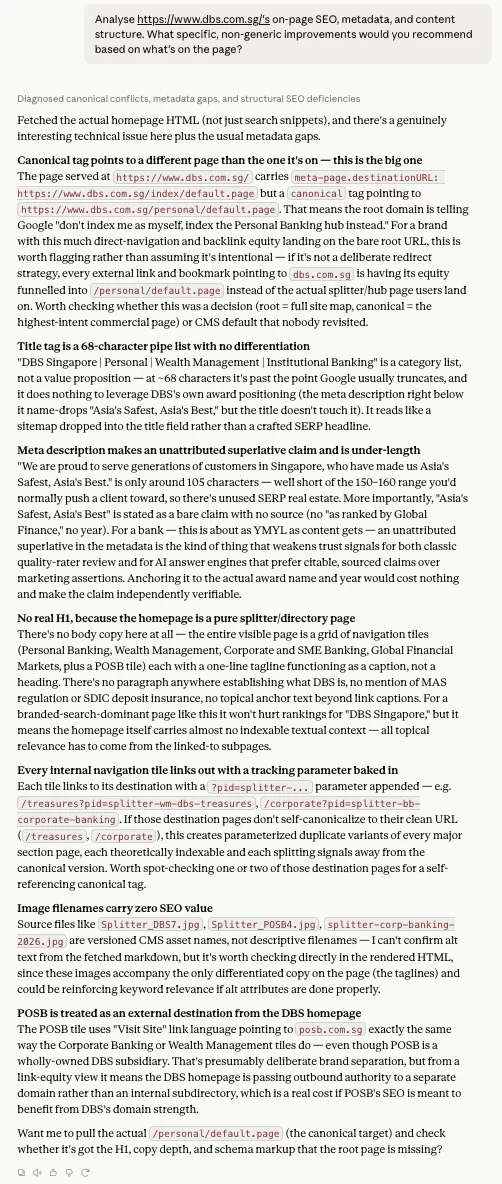
That’s the takeaway: Claude’s mission is to answer, not to judge. A missing item on its list isn’t evidence of poor SEO work, but that the model is doing exactly what it was built to do.
A Wider Issue?
Following this incident, I took some time to review the Google Business Profiles of several other digital marketing agencies in Singapore.
To my surprise, I found that a number of agencies had also received negative reviews where the business publicly stated that they were unable to identify the reviewer as a client or verify the alleged client relationship.
This suggests that our experience may not be an isolated incident.
As our investigation is still ongoing, I will conclude this article here. If there are any material developments, I will update this page accordingly.
In the meantime, I hope this serves as a reminder to fellow business owners to document everything, investigate concerns thoroughly, and respond professionally whenever questions arise.