
The GEO Gap: Why 44% of SaaS Brands Don’t Show Up in AI
Posted on: May 18, 2026
Picture this: A procurement manager at a fintech firm needs a new payroll tool. She does not open Google. She opens ChatGPT, types her question, and gets a response with three recommendations. One of them is your competitor. You are nowhere to be seen.
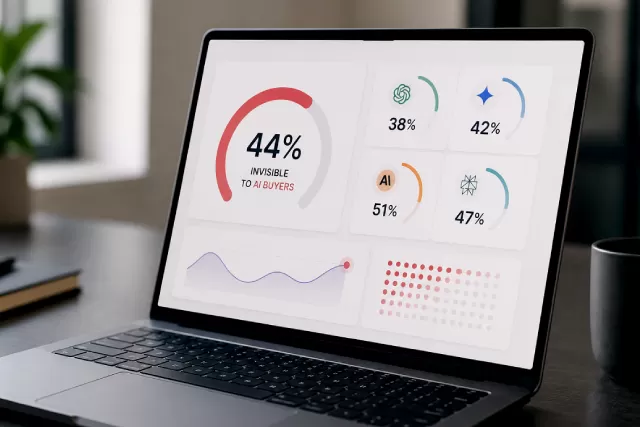
This is not a hypothetical. It is happening right now, and a 2026 Benchmark Report by DerivateX has put some sobering numbers to it. After testing 50 B2B SaaS companies across ChatGPT, Perplexity, Claude, and Gemini, the report found that 44% of B2B SaaS companies scored below 50 out of 100 on AI visibility, meaning nearly half are functionally invisible in the AI systems their buyers use daily.
Not underperforming. Not even ranking on page two. Just… invisible.
What Is the GEO Gap?
Generative Engine Optimisation (GEO) is about making sure that when someone asks an AI platform a question relevant to your product, your brand actually comes up. It is the difference between being cited in the answer and not existing in the conversation at all.
And the gap between those two outcomes is enormous. The same study found an 87-point spread between the highest scorer, Clio at 89 out of 100, and the lowest, LeadSquared at a score of just 2. These two are from the same industry, with the same category of buyers. However, they have completely different levels of AI presence.
What made Clio the runaway leader? Clarity. As the dominant legal practice management platform, Clio benefits from having no ambiguity about what it does, and AI platforms surface it as the default answer for legal tech queries. It does not just show up in its category. It is practically synonymous with it in AI’s eyes.
That distinction between being in a category and owning it in AI responses is the whole game right now.
High Traffic Does Not Equal AI Visibility
Here is the bit that catches a lot of SaaS marketers off guard. Good SEO performance does not automatically carry over into GEO. They feed into each other, but they are not the same thing.
The DerivateX report showed this clearly when looking at how different AI platforms behave. Claude is the most selective platform, mentioning only 88% of companies tested, while ChatGPT and Gemini mentioned all 100%. And platforms like Claude and Perplexity are citation-heavy by nature, meaning they will actively overlook high-traffic sites in favour of those with what researchers call Authoritative Inline Citations: content that references “.gov” sources, “.edu” research, or primary data. In other words, a well-visited site with thin sourcing loses out to a less-trafficked one that cites credible evidence throughout.
That last point is worth dwelling on. High scorers in the study averaged a mention rate of 18.8 out of 30 and a platform breadth score of 18.4 out of 20, while low scorers averaged just 3.0 out of 30 on mention rate. Rather than having better product descriptions or more polished landing pages, the gap was about how frequently and consistently these brands were showing up across the entire ecosystem that AI platforms draw from.
This Is Where FAQs Come In
One of the most effective things you can do for GEO right now is to build proper FAQ content with schema markup. It is not a coincidence that FAQs are so powerful here: research consistently shows that FAQ schema has one of the highest citation rates in AI-generated answers, with content using FAQPage schema appearing in ChatGPT, Perplexity, and Google AI Overviews significantly more than unstructured content.
Think about how your buyers actually use these tools. Do they type in keywords or ask questions?
- A HR manager in an SME might ask ChatGPT: “What is a good payroll software that handles CPF contributions automatically?”
- A founder comparing options might ask Perplexity: “What is the difference between Xero and QuickBooks for a Singapore-registered entity?”
These are specific, intent-driven questions, and structured FAQ formats are often the content that AI platforms lift directly when generating responses.
A well-built FAQ page does three things at once. First, it speaks directly to the questions your buyers are already asking. Next, it signals to AI systems that your content is structured and extractable. Lastly, it quietly increases the chance that your brand gets cited rather than skipped.
A practical starting point is to identify the 10 to 15 most common questions in your category and write thorough, specific answers with proper schema markup. For SaaS teams in Singapore, that means thinking locally. Questions around PDPA compliance, MAS regulations, CPF integration, or even something as specific as “does this tool work for Singapore-registered businesses?” are exactly the kind of queries your buyers are putting into AI tools right now.
The Sentiment Trap That Catches Good Brands Out
Here is a finding from the DerivateX report that is worth sitting with, because it is counterintuitive.
Eight of the bottom ten companies in the study had perfect or near-perfect sentiment scores. The bottleneck was not perception but presence. These companies were not viewed negatively by AI: they were simply not mentioned at all.
Many SaaS teams assume that if their brand is well-regarded, if they have solid G2 reviews and happy customers, AI will find them. But sentiment only matters once you are in the conversation. A glowing mention that appears once every ten prompts does not move the needle.
Ten companies in the study had perfect sentiment scores but mention rates of 8 out of 30 or lower. When they appeared, AI platforms described them positively. They just did not appear often enough for it to matter.
The fix is earning more mentions across more places: guest articles on industry publications, product listings on trusted directories, PR coverage from credible outlets, and structured FAQ content that gives AI systems something clear to extract every time a relevant question comes up.
What Singapore SaaS Teams Should Actually Do
Singapore’s B2B SaaS ecosystem is maturing fast. According to IMDA’s Singapore Digital Economy (SGDE) Report 2025, SME AI adoption tripled in a single year, rising from 4.2% in 2023 to 14.5% in 2024. That means more Singapore buyers, across HR, finance, operations, and beyond, are turning to AI tools to research software decisions. Now, the GEO gap is a local pipeline problem.
Here are a few things worth doing now, without overcomplicating it:
Start by testing your own visibility. Open ChatGPT, Perplexity, Claude, and Gemini and ask the questions your buyers actually ask. “What is the best [your category] software for Singapore businesses?” See what comes up. See if you come up. This takes an hour and will tell you more than most tools currently can.
Then build your FAQ content around those exact questions, not the keywords your SEO tool suggests. Write answers that are clear, specific, and locally grounded. Add FAQPage schema markup so the structure is machine-readable, not just human-readable.
Beyond your own website, think about where else your brand needs to exist. Brands that score highly in AI visibility are almost always the ones frequently cited in independent reviews, comparison articles, and analyst reports: the exact content AI models are trained on. For SaaS companies, that might mean getting listed in local tech directories, contributing to industry conversations on LinkedIn, or earning coverage in publications like e27 or Tech in Asia.
The Window Is Still Open
With nearly half of brands yet to build a meaningful GEO strategy, early movers have a real advantage available to them. The companies that build this foundation now, clear FAQ content, schema markup, consistent third-party mentions, and genuine category authority, are the ones AI platforms will cite by default in 12 months’ time The ones that wait will be watching their competitors get recommended while they wonder why their traffic is dipping and their pipeline has gone quiet.
That procurement manager opening ChatGPT? She is not going to dig through five results. She is going to go with whoever the AI recommends first. The question is whether that is going to be you.