

The AEO Era: Why FAQs Are More Powerful Than You Think
Posted on: April 20, 2026
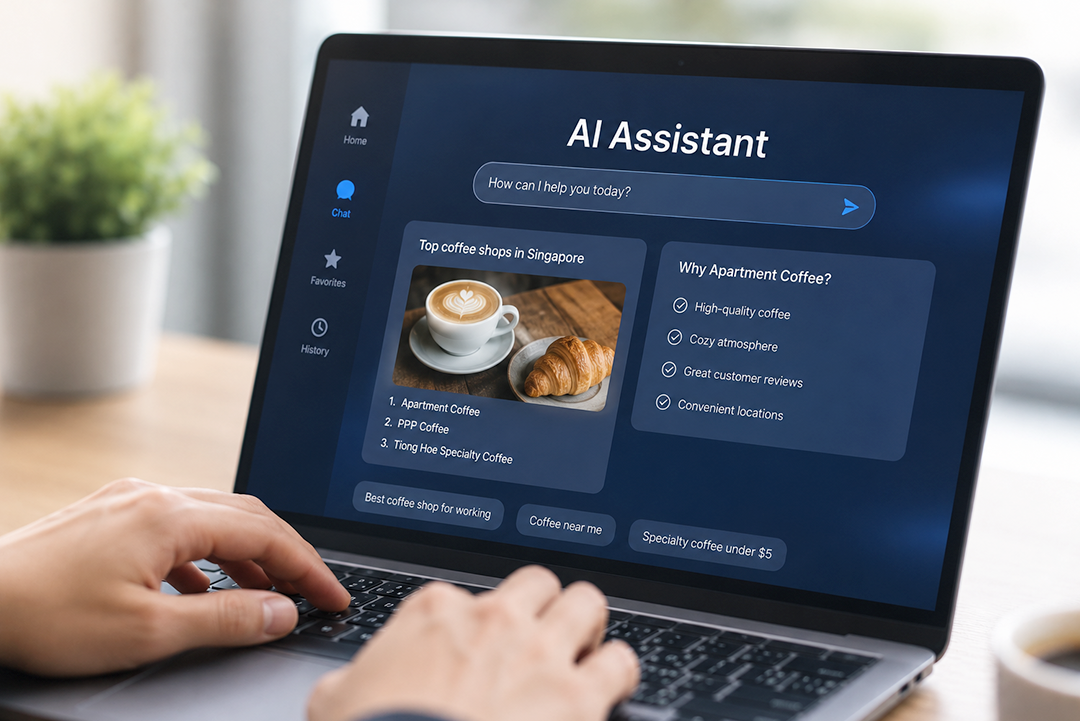
Something is quietly shifting in how Singaporeans find businesses online. The familiar routine of Googling, scrolling through a page of blue links, clicking around, that behaviour is fading. In its place, people are asking direct questions and expecting direct answers. No browsing required.
Ask ChatGPT for “the best corporate tax services in CBD” or pull up Google’s AI Overviews to find “affordable tuition centres in Jurong,” and you will notice: it does not give you a list of websites to explore. It gives you the answer.
In this new environment, the humble FAQ section has become one of the most powerful tools for visibility while most businesses are still treating it like an afterthought.
The Shift: From Ranking to Citation
Not long ago, SEO was a race to rank #1. Today, the goal has shifted. It is about being the source that AI engines actually trust and cite.
When AI engines like Google Gemini, Perplexity AI, or ChatGPT generate answers, they are not just listing websites. They are pulling information directly from content they consider credible. FAQs, by their very nature, fit this perfectly. A clear question, followed by a direct answer. That structure is exactly the language these systems are designed to read.
This shift is not just theoretical, it is already happening at scale. AI platforms generated 1.13 billion referral visits in June 2025, a 357% increase from the previous year. Pages with well-structured content were far more likely to earn those high-value citations. The way your content is organised right now directly determines whether you get surfaced or skipped entirely.
This is the new direction of SEO. It is less about being a destination, and more about becoming a trusted source of information.
GEO: Hyper-Locality & Context
As we move further into 2026, GEO (Generative Engine Optimisation) is becoming essential, especially for local businesses. One of the biggest game-changing GEO trends is the shift towards contextual, hyper-local content.
AI is getting surprisingly good at understanding Singapore’s geography, not just through postal codes, but through everyday references. When you mention things like “near the PIE exit” or “five minutes from ION Orchard,” you are giving the AI helpful context it can actually use.
And beyond location, there is also language.
A global search might sound like:
“What is the price of a gym membership?”
But in Singapore, it is more likely:
“How much is a gym near Raffles Place?” or “Are there student rates for gyms at Heartbeat@Bedok?”
By shaping your FAQs around how people actually speak and search here, you naturally tap into higher-intent queries that generic content tends to miss.
Building E-E-A-T Through Real, Useful Answers
Google’s E-E-A-T framework (Experience, Expertise, Authoritativeness, Trustworthiness) still plays a huge role in how content is evaluated. But here is the thing: AI is even stricter about this. It prefers answers that feel grounded in real-world experience, not just surface-level information.
FAQs give you a chance to show that. Instead of broad, generic explanations, you can offer specific, practical insights. For example:
Question: How do I qualify for the Singapore Employment Pass in 2026?
Answer: Under the 2026 COMPASS framework, you need at least 40 points. For instance, earning S$5,600 (or S$6,200 in finance roles) gives you 10 points. Candidates from top-tier institutions can gain an additional 20 points.
This kind of detail signals that you are not just writing about the topic, you are actively working within it.
The Technical Engine: Schema & Micro-FAQs
Getting the content right is only half the job. How it is structured behind the scenes matters just as much.
Using Schema.org markup (specifically FAQPage JSON-LD) helps search engines and AI systems clearly understand your content. Think of it as highlighting the most important parts for them.
There is also a growing shift toward what we call “Micro-FAQs.” Instead of placing everything on one long FAQ page, you break them down across your site.
- Add 3 to 5 relevant questions at the bottom of each service page
- Keep them tightly focused on that specific topic
- Make them as practical and location-specific as possible
For example, a page on “AC repair in Woodlands” could include FAQs about common HDB issues or response times in the North. It feels more helpful, and it is far more relevant.
AEO Best Practices for the Singapore Market
Here are a few practical guidelines to keep in mind:
- Answer length: Aim for 45 to 65 words. Clear, concise, and easy for AI to extract.
- Question style: Use natural, conversational phrasing that mirrors how people actually search.
- Update frequency: Refresh your FAQs every 90 days to stay relevant.
- Local context: Mention MRT stations, malls, and familiar landmarks whenever possible.
These small details make a big difference in how your content is interpreted and surfaced.
The Verdict: FAQs Are Your “API” to the AI World
In the AEO era, your website is no longer just a digital brochure. It functions more like a structured database feeding into a much larger AI ecosystem, and your FAQs are the connection point between your expertise and the questions your audience is already asking.
When done well, they do not just help a visitor on your site. They carry your brand into every platform, every AI-generated answer, every moment someone asks a question you are qualified to answer. That is the opportunity on the table. The businesses that structure their content for this shift now will be the ones getting cited tomorrow.