
Google I/O 2026: What Android’s AI Leap Means for AIO
Posted on: June 10, 2026
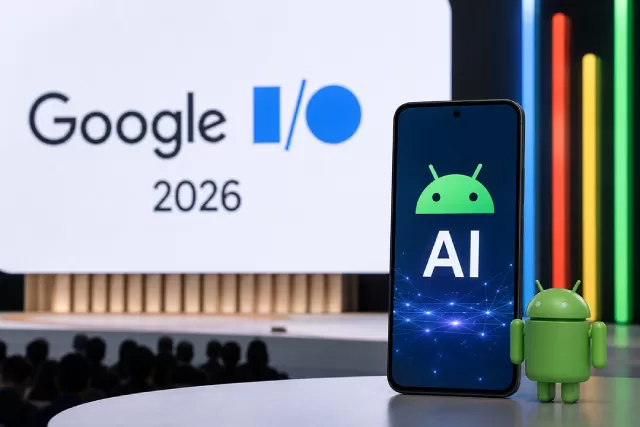
For years, the dominant question in search optimisation was simple: how do I rank? Keywords, backlinks, page speed: the variables were well-understood, even if the algorithm wasn’t. But Google’s announcements at I/O 2026 signal something more fundamental than an algorithm update. They signal a change in what search is.
At the centre of it all is Gemini, and its new role not as a chatbot, but as the intelligence layer of Android itself.
From Assistant to Agent
Sameer Samat, President of the Android Ecosystem, told CNBC, “We’re transitioning from an operating system to an intelligence system.”
That sentence deserves more attention than it’s getting in mainstream tech coverage.
What Samat described isn’t a smarter autocomplete or a shinier voice assistant. It’s Gemini becoming the interface through which 250 million+ Android users across phones, cars, watches, and laptops will interact with the internet. Gemini can now move across apps, read what’s on screen, pull information from Gmail, build shopping carts, and complete bookings, all without a user needing to open a browser, type a query, or scroll through search results.
This is the agentic turn. And for anyone working in AI-driven online optimisation (AIO), it changes everything.
Why This Matters Beyond Silicon Valley
It’s tempting to frame Google I/O as a story about American tech giants battling for AI supremacy. But the implications extend to digital strategy everywhere, including markets that are actively building their own AI-forward ecosystems.
Singapore’s AI Strategy 2.0, for instance, positions the country as a global hub for trusted, enterprise-grade AI adoption. The strategy isn’t just about building models. It’s about embedding AI into how businesses operate, how services are delivered, and how users interact with information. As Gemini becomes the default intelligence layer on Android across Southeast Asia, the question for Singapore-based brands isn’t whether this shift matters. It’s whether their content is ready to be found, parsed, and acted upon by an AI agent.
The gap between brands that optimise for agents and those still chasing traditional rankings will widen fastest in AI-forward markets. That’s not a warning. It’s an opportunity.
What AIO Looks Like in an Agent-First World
Traditional SEO operated on a simple premise: get your content in front of a human who is actively looking. AIO has already complicated this by introducing AI systems as intermediaries, systems that read, summarise, and cite content on behalf of users. But the Google I/O announcements push this further still.
When Gemini can complete a task like building a shopping cart from a recipe or booking a restaurant after scanning your calendar, it’s no longer intermediating between a user and a website. It’s replacing that interaction entirely. The user never arrives at your page. Gemini either includes your product, your service, your information, or it doesn’t.
This is the new battleground for AIO. And the rules are different.
Agent-Readability: The New Ranking Signal
If Gemini is acting as an agent rather than a search engine, the signals it uses to decide whose content to surface are fundamentally different from PageRank-era thinking. Here’s what that means in practice:
- Structured data is no longer optional
When Gemini pulls product information, availability, or pricing to build a shopping cart, it needs machine-readable signals. Schema markup, especially for products, events, reviews, FAQs, and local businesses, becomes the difference between being included in an agent’s action and being invisible to it.
- Entity clarity matters more than keyword density
AI agents don’t match keywords. They understand entities. Your brand, your products, your services need to exist as clearly defined entities in the knowledge graph. That means consistent NAP data, Wikidata presence where relevant, and structured mentions across authoritative sources.
- Citations build trust signals for agents
Gemini, like other large language models, places weight on how content is referenced across the web. If your brand is consistently cited in authoritative contexts such as industry publications, research, and established media, it builds the kind of trust signal that makes an AI agent more likely to surface you. This is the same logic behind GEO (Generative Engine Optimisation), and it applies directly here.
- Transactional readiness is now a content signal
Google’s I/O demos showed Gemini completing purchases, building lists, and making bookings. If your product or service isn’t accessible through a structured, agent-navigable flow via an API, a well-structured product page, or integration with platforms Gemini can reach, you may be optimised for search but invisible to agents.
The Human Is Always in the Loop — For Now
One nuance worth acknowledging: Samat was explicit that Gemini will return to the user before completing transactions. “The human is always in the loop,” he said. This is an important guardrail, and it means the agent-first world isn’t fully autonomous yet.
For AIO strategists, this creates a narrow but important window. The agent surfaces options and presents them for approval. That means your content, your brand, and your offer still need to be compelling to a human, just delivered through a very different interface. Think of it as the AI equivalent of a featured snippet: being the answer the agent chooses to present, in a format the user will accept.
What to Do Now
The brands that will win in an agent-first Android ecosystem are those who stop thinking about pages and start thinking about data structures, entity signals, and transactional accessibility. Concretely, that means auditing your structured data implementation across all key page types, ensuring your brand entity is cleanly defined and consistently referenced across the web, building authoritative citations through genuine thought leadership rather than manufactured backlinks, and mapping the transactional journeys Gemini might complete on a user’s behalf, then making sure your brand is positioned at each decision point.
Google I/O 2026 wasn’t just a product announcement. It was a signal that the search-to-action pipeline is collapsing into a single AI layer. The brands ready for that layer will be the ones that invested in agent-readability before it became the standard expectation.
The operating system is becoming an intelligence system. The question is whether your content strategy is keeping up.