
OpenAI’s GPT-Live Signals a Voice-First Era for AEO
Posted on: August 31, 2026
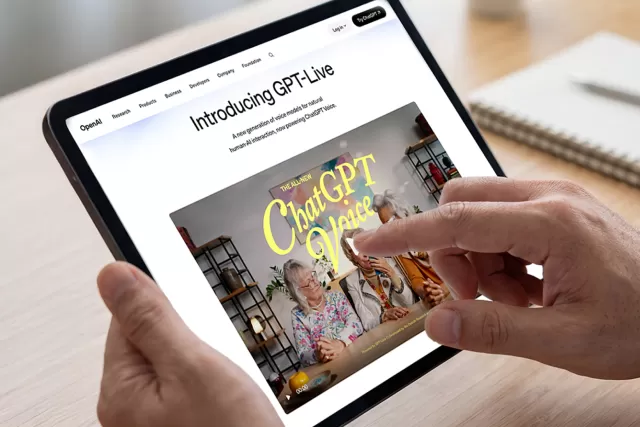
Picture a customer asking their phone a question out loud and getting an answer that sounds less like a machine reading a script and more like a knowledgeable friend who happens to listen while they talk. That is the experience OpenAI is now selling with GPT-Live, a voice model built to speak and listen at the same time. For Singapore businesses that have spent years chasing keyword rankings on a results page, this shift towards spoken, real-time AI conversation adds a genuinely new dimension to how customers discover brands.
OpenAI rolled out GPT-Live to ChatGPT users across iOS, Android and web on 8 July 2026, replacing the old, stilted back-and-forth voice mode with something that behaves far more like a real conversation. The launch carries weight well beyond consumer tech circles, and it reflects a broader shift in how people conduct AI search, one that changes how content needs to be structured if it wants to be found, understood, and repeated back to a customer standing in a queue or driving to a meeting.
What GPT-Live actually does
GPT-Live uses full-duplex technology, meaning the model can listen and respond simultaneously rather than waiting for a person to finish speaking before processing what they said. OpenAI says the system interrupts less often and drops in natural acknowledgements such as “mhmm” while a user is still talking, closing the awkward gap that made older voice assistants feel robotic.
Underneath the friendly delivery, the mechanics matter more to marketers. When a conversation calls for a web search or a more complex piece of reasoning, GPT-Live quietly delegates that work to OpenAI’s GPT-5.5 model in the background, then folds the answer back into the spoken response without breaking the flow. Visual cards for things like maps, weather, and sports scores appear alongside the voice reply, and users can choose how much reasoning effort the model applies. In short, the search step has not disappeared. It has simply moved behind the scenes.
Why this changes the game for AEO and GEO
Voice interactions strip away the search results page entirely. There is no list of ten blue links to scan, only the one answer the model chooses to speak aloud. That raises the stakes considerably for how businesses structure their content, because the model is not just picking a page to display. It is picking the words it will say to a real person in real time.
Content that performs well in this environment tends to share a few traits: direct answers positioned at the very start of a page or section, short, quotable paragraphs instead of long build-ups, and clearly labelled questions and answers that mirror how people actually speak. Structured data such as FAQPage and HowTo schema still plays a role, since it gives models an explicit, machine-readable version of the answer instead of forcing them to infer one from paragraphs of prose. None of this replaces solid SEO fundamentals. It sits on top of them, rewarding the businesses that have already done the work of writing clearly rather than cleverly.
What this means for Singapore SMEs
Singapore’s mobile-first, always-on consumer habits make voice-driven discovery worth taking seriously instead of dismissing it as a novelty. Someone asking their phone for “a good confinement nanny agency near Bishan” or “halal caterer for a 50-pax corporate lunch” while multitasking is exactly the kind of query GPT-Live is designed to handle smoothly, and the business that gets read out as the answer wins the moment. The business that never structured its content for that answer does not get a second chance in the same conversation.
Practical steps for owners and marketing managers are refreshingly unglamorous. Keep FAQ pages current and phrase them as real customer questions, not marketing copy. Make sure business listings, operating hours, and service areas are accurate everywhere they appear online, since voice models still lean on real-time web data to fill in gaps. Add schema markup where it is missing. None of this is a quick fix, and results from these kinds of technical and content foundations typically build over three to six months in the same way traditional SEO does, with the fuller benefit compounding over six to twelve months as more voice queries pass through.
This is also a good moment to think about how prompts themselves are shaping visibility. As AI systems increasingly rely on structured, well-labelled content to generate their answers, the discipline behind writing for prompts is quickly becoming an AI SEO asset in its own right, and the same clarity that helps a business get recommended in a chat interface will help it get spoken aloud in a voice one.
A few quick questions we’re already fielding from clients
Does this replace Google Assistant or Siri for search? Not directly, but it adds another surface where customers can ask questions and get a spoken answer instead of a page of links, which is exactly the behaviour AEO needs to account for.
Do I need a separate voice SEO strategy? Not a separate one. The same clear, well-structured, question-and-answer style content that supports AI Overviews and chatbot answers also supports voice delivery. Think of it as one AEO foundation serving several channels at once.
How quickly will this affect my business? Adoption will vary by industry and audience, and Singapore’s consumers tend to pick up new AI features quickly given how mobile-first the market already is. Businesses that get their FAQ content and structured data in order now will simply be ready whenever their customers start asking questions out loud.
Voice interfaces are unlikely to replace typed search any time soon, but they are quietly becoming a parallel channel that most businesses have not yet optimised for. The agencies and SMEs that treat this as an extension of AEO, not a separate problem to solve later, will simply have more chances to be the answer a customer hears the next time someone asks their phone a question out loud.