
ChatGPT Ads Are Here, What Does It Mean for AEO Strategy?
Posted on: May 28, 2026
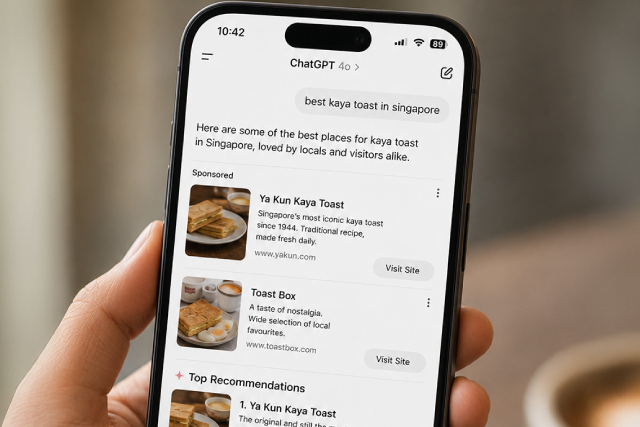
Something significant happened in February 2026, and if you are a business owner or marketer in Singapore, you should probably pay attention.
OpenAI began testing ads inside ChatGPT on 9 February 2026, placing sponsored content beneath AI-generated responses for users on the free and Go plans. It started in the United States, and has since expanded to include pilots in Canada, Australia, and New Zealand, with OpenAI signalling its intention to roll out to many more markets throughout the year.
That might sound like a distant development for Singapore, but for anyone who has been building an Answer Engine Optimisation (AEO) strategy around appearing organically in AI-generated responses, this is a shift to take seriously.
So, What Exactly Are ChatGPT Ads?
Simply put, they are sponsored placements that appear beneath ChatGPT’s organic response. Currently, there are two confirmed formats, and both are clearly labelled as “Sponsored” and kept visually separate from the AI’s actual answer.
The first is a product card, most likely to appear for e-commerce and retail queries. When a user asks something related to shopping or products, a sponsored card shows up beneath the answer, displaying the brand logo, product name, price, and availability. The second is a text-based sponsored link, similar in spirit to a traditional search ad but placed within a conversational interface. It appears when a user’s query aligns with a relevant advertiser’s category.
As for who sees them: ads currently appear only for users on ChatGPT’s free and Go tiers. If you are on Plus, Pro, Business, or Enterprise, you will not see ads. OpenAI has also confirmed it will not show ads to users under 18. On the advertiser side, access is still limited. The pilot has involved major global agency groups, with a reported minimum spend of US$200,000, making it an enterprise-level play for now. OpenAI has signalled that a self-serve platform is coming later in 2026, which is when smaller businesses will realistically be able to participate.
It is also worth being clear on what the ads do not do. OpenAI has been firm that sponsored content does not influence ChatGPT’s answers. The organic response remains independent. But here is the thing: even if the ads are separate, they are still visible. They appear right after the answer your content might be part of, and for users in a buying mindset, that placement is crucial.
How Does ChatGPT Decide Which Ad to Show?
This part is significant for anyone working on AEO strategy. OpenAI matches ads to the topic of the user’s current conversation, not to keywords in the traditional sense. It starts with what is being discussed in the chat thread and matches those topics to relevant ads submitted by advertisers. If a user has opted into personalised ads, past chat history and previous ad interactions may also factor in.
What this means in practice is that ad relevance is driven by conversational context and intent, not by the kind of keyword bidding most marketers are used to from Google Ads. Think of a user in Singapore asking ChatGPT: “what is a good accounting software for a small business?” A relevant software provider whose ad content aligns with that topic could appear beneath the answer, even if they never bid on that exact phrase as a keyword.
For brands thinking about AEO, this connection is important. The same signals that help your content get cited organically, clear topic authority, structured answers, and strong entity recognition, are likely to be the same signals that inform how conversational ad matching develops over time.
The Hybrid Model Is No Longer Optional
For years, marketers have spoken about being “everywhere your audience is.” In 2026, that principle has extended into AI interfaces. Your audience is now discovering brands through AI assistants that summarise options without always sending a click, and AI shopping assistants scan the web to make recommendations. If your content is not structured to be cited and your brand is not showing up in that ad space when the moment calls for it, you are handing visibility to a competitor.
This is one of the GEO trends of 2026; the lines between earned and paid visibility inside AI platforms are beginning to blur, and businesses need strategies that account for both.
The brands winning in search right now are not the ones chasing one channel at a time. They are the ones building a system where technical SEO, content design, authority building, structured data, and user experience all work together. Add ChatGPT ad placements to that mix, and you have a more layered picture than most businesses currently plan for.
What This Means For Singapore Businesses Specifically
Singapore is one of the most digitally active markets in the region, and the pace of AI adoption here is accelerating fast. According to IMDA’s Singapore Digital Economy (SGDE) Report 2025, Singapore’s SME AI adoption rate more than tripled in just one year, rising from 4.2% in 2023 to 14.5% in 2024. That is a meaningful shift, and it reflects a business community that is clearly taking AI seriously.
What that means on the ground is that more businesses are already using AI tools, and more consumers are using AI to make decisions. A customer looking for a legal firm, a renovation contractor, or an F&B concept in Singapore is increasingly likely to ask ChatGPT first rather than head straight to Google. If your brand is not showing up in that response, either as a cited source or eventually as a relevant sponsored result, you are missing a touchpoint that is only going to grow.
For most businesses, the practical answer is not to abandon what is working. Organic AEO remains valuable. AI-driven visitors convert at 4.4 times the rate of standard organic visitors and spend 68% more time on site, and users who arrive via AI citations tend to be further along in their research process. That makes being cited organically still worth pursuing actively.
But it also means the conversation around AEO strategy needs to expand.
What Should You Actually Do?
There is no need to overhaul everything at once. Here are four practical things worth building into your strategy:
1. Prioritise Content Clarity And Structure
Answer clarity non-negotiable: your pages need to state definitions, comparisons, steps, and positions in ways that can be lifted cleanly into AI-generated summaries. This remains the foundation of any AEO approach, regardless of whether ads are part of the picture.
2. Build For Local Intent
The most important focus areas in 2026 include leveraging local pages for geographic visibility, implementing answer-first content formats, and maintaining entity consistency. If your business serves a specific area or niche in Singapore, make sure that comes through clearly in your content so that AI systems, and eventually ad-targeting tools, can accurately categorise and surface you.
3. Watch Where The Ads Expand To
ChatGPT ads are not yet running in Singapore, but given the platform’s stated intention to grow internationally and Singapore’s already high AI adoption rates, it is a matter of when, not if. Getting your AEO foundations solid now means you are better placed to layer in paid strategy when that option becomes available locally. When the self-serve platform does open up, businesses that have already built topic authority and entity clarity into their content will have a head start.
4. Do Not Neglect E-E-A-T Signals
Google’s continued emphasis on Experience, Expertise, Authoritativeness, and Trustworthiness (E-E-A-T) directly targets low-effort AI content. The same principle applies across AI platforms. The more your content demonstrates genuine expertise and is backed by credible sources, the more likely it is to be cited organically and to build the brand authority that supports paid efforts too.
The Bigger Picture
It would be easy to read this development and feel anxious about yet another layer of complexity in digital marketing. But the more useful frame is opportunity.
A Truist analyst note called 2026 an “inflection year” for large language model-powered ads, noting that within the next several years, LLM-powered ad channels are expected to become one of the most important pillars of the digital ad industry alongside Search, Social, and Retail Media.
Singapore businesses that start thinking about this now, building strong AEO content foundations while monitoring how ChatGPT ads develop, will be better positioned than those who wait until the format is fully mainstream to start paying attention. The good news is that the skills and habits that make for strong AEO work, writing clearly, answering questions directly, earning trust, and structuring content well, are the same ones that will matter when paid AI advertising becomes part of the mix too.