
Chinese AI Models Hit 46% Share: What It Means for AEO
Posted on: July 21, 2026
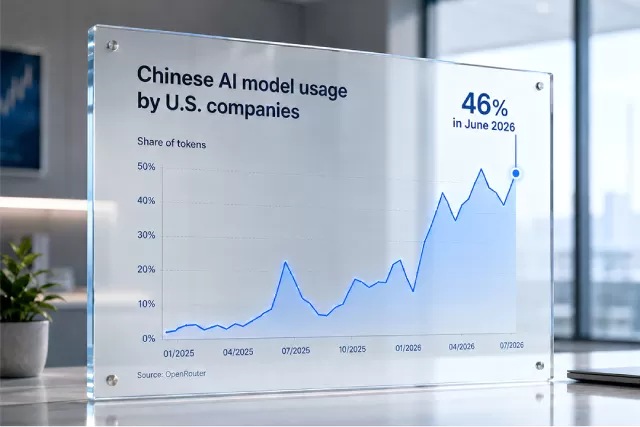
The ground under answer engine optimisation just shifted again, and this time it’s not about a new SGE update or a Perplexity feature. It’s about which models are actually generating the answers in the first place.
According to a CNBC report published July 7, Chinese open-source models like DeepSeek and Zhipu’s GLM 5.2 are eating into the enterprise AI market that Anthropic and OpenAI have dominated for the past two years. The pitch is simple and, for a lot of finance teams, hard to argue with: comparable performance at 60-90% lower cost.
The Numbers Behind the Shift
Enterprises are listening, and they’re not just kicking the tires. Lindy, an AI agent startup, moved 100% of its traffic from Claude to DeepSeek and expects the switch to save it millions of dollars a year. That’s not a hedge or a pilot program, it’s a full migration, and it’s exactly the kind of decision other cost-conscious engineering teams are watching closely.
The market-level numbers back up the anecdote. On OpenRouter, a marketplace that routes API traffic across dozens of models, the share of enterprise tokens going to Chinese models has held above 30% on a weekly basis, up from just 11% a year earlier — nearly a tripling of share in twelve months, in a market that was supposed to be a two-horse race between OpenAI and Anthropic.
The performance story is closing just as fast as the cost story. GLM 5.2 reportedly lands within a single point of Opus 4.8 on a key agentic benchmark, at roughly a fifth of the cost. When a model is a rounding error away from frontier performance and five times cheaper, “we’ll stick with the incumbent for now” stops being a safe default and starts being a line item that finance and engineering leadership will ask about every quarter. Put those threads together and a headline figure like 46% share in some usage segments stops looking like an outlier and starts looking like a trendline.
Why This Is an AEO/GEO Story, Not Just a Cost Story
It’s tempting to file this under “enterprise procurement news” and move on to the next SEO update. That would be a mistake, and here’s the mechanism that makes it one.
The stakes were already high before Chinese models entered the picture. Separate research has found that 44% of SaaS brands don’t show up in AI at all when prospects ask category questions, and that’s the baseline against a single dominant model family. Add three or four more model families into the enterprise stack, each with its own retrieval logic and blind spots, and the odds of staying invisible only compound.
The model layer is the thing doing the retrieval, ranking, and citing when an AI system answers a question about your brand, your product, or your category. Every model has its own training data, its own retrieval behaviour, and its own opinions about what counts as a trustworthy, citable source. GPT and Claude are not stand-ins for “AI” as a category anymore, if they ever truly were. They’re two players in a field that now includes DeepSeek, GLM, Qwen, and others, each with meaningfully different citation habits, different crawl and training data mixes, and different thresholds for what they’ll surface as an authoritative answer.
For the past couple of years, most AEO/GEO strategy has implicitly been built around a narrow question: does ChatGPT cite me, and does Claude cite me? That was reasonable when those two systems handled the overwhelming majority of enterprise AI traffic, and most GEO tooling and reporting frameworks were built around exactly those two endpoints. It stops being reasonable the moment a third of enterprise traffic, and climbing, is running through models most brands have never audited themselves against, let alone tracked in a dashboard.
The Visibility Gap
If a company’s research, support, or internal tooling runs on GLM or DeepSeek instead of GPT or Claude, and that model has never learned to trust your content the way OpenAI’s or Anthropic’s pipelines have, you’re effectively invisible in that workflow, even if you’ve done everything right for ChatGPT. A brand that ranks well in Claude’s citations but has never been evaluated against DeepSeek isn’t “covered,” it’s covered for a shrinking fraction of the actual traffic.
There’s also a data-provenance angle that’s easy to miss. Open-source Chinese models are trained differently than the closed frontier labs, often leaning more heavily on publicly crawlable web content, structured data, and technical documentation rather than the licensed data partnerships OpenAI and Anthropic have increasingly relied on. The signals that earn a citation in GLM or DeepSeek may not be the same signals that earn one in GPT or Claude — a brand’s earned-media wins might carry real weight with one model family and close to none with another.
Why the Answer Surface Is Expanding, Not Just Shifting
Cheaper inference doesn’t just swap one model for another inside existing products, it lowers the cost floor for building AI features at all. That means more startups ship more agents, more copilots, and more vertical-specific assistants, each one a new answer surface that didn’t exist a year ago.
Lindy is one company. Multiply that decision by every other AI-native startup now able to run a competent agent stack at a fifth of the cost, and the number of places a customer’s question about your brand can get answered by AI is expanding faster than most GEO programs are expanding to cover it. You’re not just chasing a moving target on two models anymore, you’re chasing a growing number of targets, most of which don’t have a name recognizable enough to show up on anyone’s radar yet.
What Brands Should Actually Do About It
The instinct might be to wait until Chinese models have a more visible presence in the tools your customers use directly. That’s the wrong bar. B2B buyers, procurement teams, and internal enterprise workflows are already interacting with your brand through agents built on these models, even if consumers aren’t chatting with DeepSeek directly the way they chat with ChatGPT on their phones. By the time the shift is visible to consumers, it will already be well underway in the enterprise tools quietly influencing purchasing decisions.
A few concrete moves make sense starting this quarter. Test your brand’s visibility and citation quality on DeepSeek and GLM directly, the same way you’d test on ChatGPT or Perplexity, rather than assuming performance carries over. Run the same category and comparison queries you already use for GPT/Claude audits and note where the citations, recommendations, or factual accuracy diverge.
Look closely at how these models are trained and what they weight — technical documentation and schema markup may be doing more work with this model family than your GEO team previously assumed. Expand your monitoring stack so model diversity is a first-class metric rather than an afterthought: if your dashboard still has just two columns, “ChatGPT” and “Claude,” it’s already out of date. And loop procurement and engineering conversations into GEO planning — if your own company or your key enterprise customers are evaluating a move like Lindy’s, that’s a direct signal about which models your content needs to perform well on next.
The cost war between US and Chinese labs will keep making headlines for the earnings and geopolitics angle. For anyone doing AEO or GEO work, the more useful headline underneath it is quieter: the number of models deciding whether your brand gets mentioned is growing, and most brand visibility strategies haven’t caught up yet.