
Google AI Mode Ads Reach Singapore: What SMEs Should Do
Posted on: November 5, 2026
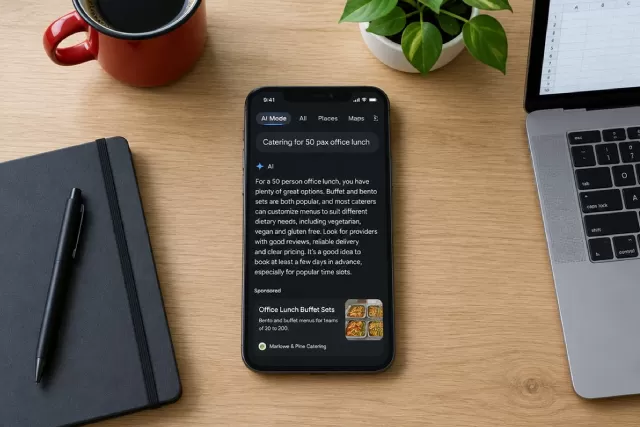
Your next customer may never see a traditional results page. They type a long, conversational question into Google, such as who can cater lunch for 50 colleagues, read an AI-written answer, and meet a sponsored result in the middle of it. On 28 October 2026, Google confirmed that this experience is being scaled to Singapore.
For anyone buying or managing Google Ads services in Singapore, the announcement changes where your budget can appear, even though no new campaign type has to be built. Here is what Google said, how it fits with search and AI visibility, and what we would do about it.
What Google announced
On 28 October 2026, Google said it is scaling ads in AI Mode, its conversational search experience, in ten markets: Australia, Canada, India, Kenya, Malaysia, New Zealand, Nigeria, Pakistan, the Philippines and Singapore. Brazil, Mexico and the United Kingdom are planned for Q4 2026. Ads carry a “Sponsored” label.
Google says it is “now scaling” ads in AI Mode in these markets, and its Ads Help page already lists Singapore among the places where ads within AI Overviews and AI Mode are available, in English. Some trade coverage describes the rollout as under way, so Singapore advertisers should treat the ads as live or going live now. Google has not published an exact Singapore start date, so some accounts may see them before others. In the US, Google is also introducing multiturn ads, which can appear in response to follow-up questions within the same AI Mode conversation. The rollout is currently limited to the US, with no other markets announced.
How this connects to AI search
Paid and organic visibility now share the same answer. Brands compete for attention inside AI search, where a sponsored placement and an AI-written summary sit on the same screen, and the shopper often reads both before clicking anything. A business with strong organic citations and a well-run ad account is far better placed than one with only one of the two.
How advertisers get in
The short answer to a question many business owners ask: yes, this is still normal Google Ads. There is no “target AI Mode” setting and no separate campaign to build. Google’s auction matches your existing ads to the shopper’s conversational question and the AI answer around it. According to Google’s Ads Help pages, eligibility works like this:
- Existing Search, Shopping and Performance Max campaigns take part automatically, using text and Shopping ads.
- AI-powered targeting, such as broad match or AI Max for Search, is eligible to match exploratory questions. Exact and phrase match serve only on direct commercial-intent queries.
- Google recommends pairing that targeting with Smart Bidding and strong conversion data. It presents this as good practice, not a requirement.
- You cannot target AI Overviews or AI Mode on their own, or opt out separately, although negative keywords and brand exclusions still apply.
- Results sit within standard campaign and search-terms reports, with no separate AI Mode breakdown.
Why Singapore businesses should pay attention
AI Mode queries are around three times longer than traditional searches, according to Sundar Pichai’s remarks reported by TechCrunch. Longer questions mean more specific intent, and that suits Singapore’s service businesses, from renovation firms to corporate caterers, whose customers already ask detailed questions before they enquire.
English-only delivery is not a barrier here, since English dominates commercial search in Singapore. The real risk is invisible spend. If broad match or AI Max is running loosely, your ads may now appear on exploratory questions that rarely convert, and you will not see an “AI Mode” line to judge them by.
We would also treat Google’s early performance claim with care. The company says click-through rates for sponsored product listings in AI Mode are already similar to organic ones, but its footnote cites internal US data from 20 August to 3 September 2026, and it relates to product listings rather than lead-generation services.
Smaller advertisers should think about budget share too. A fixed monthly budget now spreads across more surfaces, so a campaign that delivered steady enquiries in September may behave differently by December without any change on your side. Compare cost per enquiry month on month, and judge results by the number of qualified leads, not clicks.
Why Google wants this inventory
Google Search and other revenue grew 12% in Q3 2026, against 17% in Q2 and 19% in Q1, and management said lower monetisation in AI Mode weighed on growth. That gives Google a clear commercial reason to build more ad formats into AI answers. Expect further changes, which is why a one-off account audit will not be enough. This follows the ChatGPT Ads Launch in Singapore on 23 September 2026, and the direction is the same: answer engines are becoming advertising platforms.
What to do now
There is no need to rebuild campaigns, but a few checks are sensible this week:
- Review match types and confirm which campaigns use AI Max or broad match.
- Add negative keywords and brand exclusions for queries you never want to pay for.
- Read the search-terms report weekly and look for longer, conversational phrases.
- Check that conversion tracking records real enquiries, since automated bidding learns from it.
- Make sure each landing page answers a specific question clearly, because both the ad and the AI summary lead people there.
When you read the search-terms report, filter for queries of six words or more and sort them by cost. Conversational phrases such as “caterer for 50 colleagues with halal options” signal genuine buying intent, so note which ones lead to enquiries and build ad copy and landing page sections around them. Queries that spend money without producing an enquiry are candidates for negative keywords. Repeat the exercise monthly, since the mix of queries will shift as AI Mode usage grows.
Organic visibility still shapes trust
Shoppers tend to read the AI summary first and the sponsored result second. If your business is named or cited in that summary, your paid listing benefits from the same familiarity. Clear service pages, accurate Google Business Profile details and genuine reviews give the AI something reliable to quote, and they also lift the quality of the traffic your ads send to the same pages.
Common questions
Are Google AI Mode Ads still normal Google Ads? Yes. Your existing Search, Shopping and Performance Max campaigns take part automatically when Google’s auction finds your ad relevant to both the question and the AI answer, so there is no extra setup step and no separate budget.
Will my ads show in Singapore straight away? Google has named Singapore but has not given a date, so watch your search-terms data.
Does this replace SEO? No. Organic content still feeds the AI answers that surround the ads, and results from SEO typically take 3 to 6 months to show.
The bigger picture
Search is turning into a conversation, and the conversation now carries advertising. Singapore businesses that measure what their ads actually trigger, and keep their organic content clear enough to be cited, will be in the strongest position as Google adds formats through Q4 2026 and beyond.