
OpenAI Axes Atlas, But Browser-Based GEO Marches On
Posted on: September 14, 2026
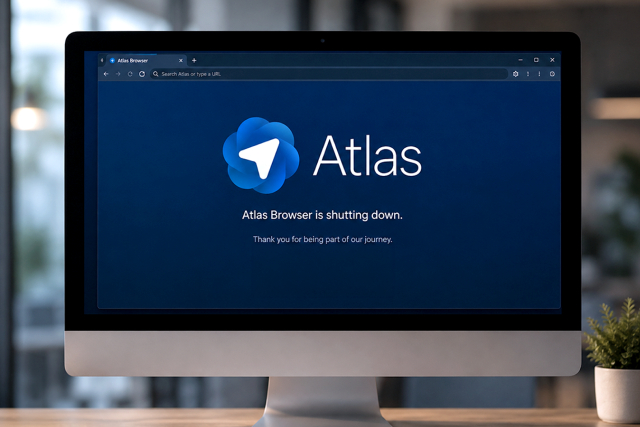
Barely nine months after launching Atlas with considerable fanfare, OpenAI has switched it off. That is a fast reversal even by the standards of an industry that moves quickly, and it raises a genuinely useful question for anyone building a content strategy around AI search: was Atlas a false start, or is agentic browsing about to become more important, not less?
OpenAI confirmed on 9 July 2026 that it was discontinuing Atlas, the standalone browser it launched in October 2025 to let ChatGPT read webpages, fill forms, and complete multi-step tasks on a user’s behalf. The stated reason was refreshingly blunt: a directive from OpenAI’s applications leadership to cut back on side projects, paired with the internal conclusion that “the browser is a feature, not the destination.” Rather than abandoning agentic browsing altogether, OpenAI is redistributing Atlas’s capabilities into three places already familiar to users: a Chrome extension that gives ChatGPT context on whatever page someone is viewing, an upgraded desktop app with a more capable built-in browser for logins and downloads, and a cloud-based browser that runs on OpenAI’s own servers so an agent can complete tasks even while a user is offline. This is a direct signal for how businesses, and any GEO agency advising them, should think about browser-level AI visibility going forward.
What this shift actually means
The lesson here is not that AI browsing failed. It is that a dedicated browser turned out to be the wrong packaging for it. Perplexity’s Comet, launched roughly a year before Atlas, continues operating as a standalone browser and remains popular with users who want deep research capabilities, while The Browser Company’s Dia offers a “skills” system for repeatable, page-scoped AI workflows, and Opera’s Neon leans into offline task completion. None of these products are shrinking. If anything, industry coverage from mid-2026 frames the competition as having moved beyond search entirely, with companies now fighting over “which company’s AI gets to act on your behalf inside the browser,” not which browser simply displays the most relevant results.
For website owners, the practical distinction between “a standalone AI browser” and “AI browsing features folded into existing tools” is smaller than it looks. Whether a user’s agent lives in a dedicated app or a Chrome extension, it is still reading a webpage, extracting information, and sometimes acting on it without a human clicking through every link manually. Atlas’s shutdown does not remove that behaviour from the web. It simply relocates where it happens.
Why this belongs in a GEO conversation
Much like the moment Google Interactions API went generally available and forced a rethink of how Gemini models interact with structured content, Atlas’s shutdown is another wake-up call for GEO, just from a different angle. It confirms that agentic reading and acting on web content is not a passing experiment tied to one product. It is a capability multiple major platforms are converging on, even as the specific products carrying it come and go.
Content built for agentic browsers needs the same foundations that support other forms of AI visibility: clean, well-structured HTML that does not rely on obscure JavaScript rendering to display key information, schema markup that clearly identifies what a page is about and who wrote it, and logically ordered content that an agent can parse without needing to guess at intent. Forms, checkout flows, and account dashboards deserve particular attention, since agentic browsers are explicitly designed to fill them in and complete transactions, and a confusing or inaccessible form is now a lost conversion in a way it never quite was when only humans were filling it in.
What Singapore SMEs should actually do
Precise market-share figures for AI browsers specifically remain thin, and no credible third-party research firm has published definitive adoption numbers for the Singapore market yet. That uncertainty is not a reason to ignore the trend, though it is a reason to prioritise sensibly rather than overhaul an entire website overnight. A few grounded steps:
- Test how your key pages, particularly product and booking pages, render and behave when accessed through an AI browsing tool, instead of assuming standard SEO testing covers this adequately.
- Simplify forms and checkout flows where possible, since these are precisely the interactions agentic browsers are built to automate on a user’s behalf.
- Keep structured data current and complete, as this remains the clearest signal available for helping any AI system, browser-based or otherwise, understand a page correctly.
Is this actually urgent?
Not in the sense of requiring an emergency response. Atlas itself never achieved mass adoption in Singapore, and its shutdown alone changes little for most local businesses. What deserves attention is the pattern behind it: three separate well-funded companies have now shipped some form of agentic browsing within a year of each other, and even the one that discontinued its standalone product chose to fold the capability into tools with a far larger existing user base instead of abandoning it. That is a stronger signal of staying power than a single product’s longevity ever was.
This is not a call to panic about a shutdown that, on its own, affects a relatively small number of Atlas users. It is a reminder that the underlying capability behind Atlas is still very much alive and spreading across tools people already use daily.
Is this actually different from what came before?
Browsers themselves have quietly absorbed AI features for a couple of years now, from summarising a page to answering questions about it. What Atlas represented, and what its successors continue to represent, is a step beyond that: an agent that does not just describe a page but acts on it, clicking through checkout flows and filling in forms without a person driving each step. That distinction, reading versus doing, is the one businesses actually need to plan around, regardless of which specific product ends up carrying it forward.
Products in this space will keep launching, merging, and occasionally disappearing as companies figure out where agentic browsing fits best. The safer bet for any business is optimising for the underlying behaviour instead of betting on any single product surviving.