
Prompt Recommendation: Why It’s Becoming an AI SEO Asset
Posted on: July 16, 2026
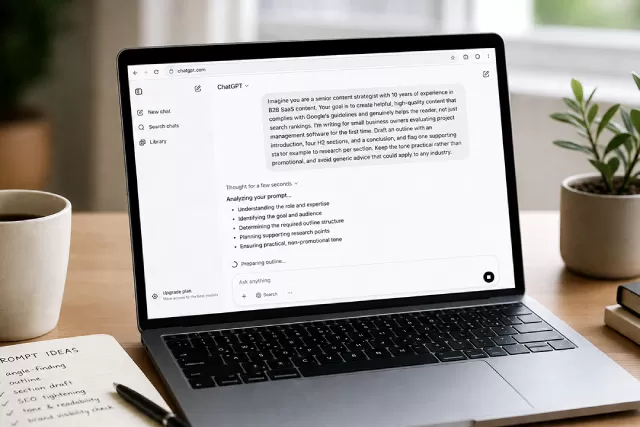
For most of the last few years, a “prompt” was just a throwaway instruction — type something into ChatGPT, get an answer, move on. That’s changed. A lot of people — marketers, content writers, business owners doing their own research, anyone who uses AI tools regularly — are now actively searching for and swapping the exact prompts that got someone a genuinely useful result, instead of a generic one. If you use AI tools as part of your work, chances are you’ve already got a small stash of prompts you keep coming back to. If you don’t, it’s worth building one, because the gap between a mediocre AI output and a useful one almost always comes down to how the prompt was written, not which tool answered it.
There’s a second reason this is worth paying attention to, and we’ll come back to it later: the same prompts people use to research a product are increasingly typed into ChatGPT or Perplexity instead of Google, which makes them a small but growing form of buyer-intent data. Mostly, though, this is about the prompts themselves — and there’s an actual strategy behind writing one that works, rather than just guessing.
What Makes a Prompt Actually Work
Most people write prompts as one casual sentence — “write me a blog post about remote work.” That works, technically, but the output is usually generic, because the AI has almost nothing specific to work with. A prompt that reliably produces something usable is built from a few deliberate pieces:
- Role: Tell the AI who it’s supposed to be. “Imagine you are a content writer with 10 years of experience” gets a noticeably different register of answer than no role at all.
- Objective: State the actual goal, not just the task. “Your goal is to create helpful, high-quality content that complies with Google’s guidelines” points the output somewhere specific instead of just “somewhere.”
- Context: Give it the specifics that make an answer usable — the audience, the industry, the format, the content it needs to sit alongside.
- Instructions: Say exactly what you want and how it should be structured — an outline, a word count, a list of angles, a table.
- Constraints: Set the boundaries — a tone to avoid, a length to stay under, what “good” excludes as much as what it includes.
Put those together, and a prompt like this is what you get:
“Imagine you are a content writer with 10 years of experience in B2B SaaS content. Your goal is to create helpful, high-quality content that complies with Google’s guidelines and genuinely helps the reader, not just search rankings. I’m writing for small business owners evaluating project management software for the first time. Draft an outline with an introduction, four H2 sections, and a conclusion, and flag one supporting stat or example to research per section. Keep the tone practical rather than promotional, and avoid generic advice that could apply to any industry.”
That’s a longer prompt than “write me a blog post,” and it’s also the difference between an outline you have to rewrite from scratch and one you can actually work from. Once you’ve got a version of this that works for your team, it’s worth saving — the same skeleton gets reused across dozens of pieces with only the context and topic swapped out.
Prompts for Research and Ideation
This is the easiest place to start, and probably where most people already are without realising it’s a skill.
- Angle-finding: “Give me eight distinct angles on remote-team productivity for a B2B SaaS audience, and flag which ones are already overused in this space.”
- Content gap: “Here are the top five articles ranking for ‘[keyword]’: [paste URLs or a short summary of each]. What angle, format, or piece of information are all five missing?”
Prompts like these turn an hour of brainstorming into a few minutes of triage — you’re not outsourcing the thinking, just skipping the blank-page stage.
Prompts for Drafting
- Outline: “Draft an outline for a post on [topic] aimed at [audience], with one supporting stat or example to research per section.”
- Section draft: “Write the introduction and first H2 section for this outline: [paste outline]. Open with a specific scenario rather than a general statement, and keep paragraphs under four sentences.”
These get you a scaffold to react to and rewrite, rather than a blank page to fill. It’s a low-risk place to build the habit.
Prompts for Editing and Optimising
- SEO tightening: “Review this draft for ‘[target keyword]’. Where does the keyword or a close variant naturally fit that it’s currently missing, and where is it forced or repeated unnecessarily?”
- Tone and readability: “Rewrite this paragraph so a reader with no background in [topic] can follow it, without losing any of the specific detail: [paste paragraph].”
Prompts for Checking How AI Talks About Your Brand
This is the AI SEO end of prompt writing, sometimes called generative engine optimisation (GEO) — testing how ChatGPT, Perplexity, Gemini, and Claude answer the questions your buyers are already asking, and whether your brand shows up in the answer at all. The prompts here look less like instructions and more like the questions a real customer would type in:
- Branded: “What do people think of [Brand]’s project management software?”
- Category: “What are the best project management tools for small teams?”
- Problem-solution, no brand named: “How can I keep a remote team on track without micromanaging?”
- Comparison: “[Brand] vs. [Brand] — which is better for a 10-person startup?”
Running a set like this across the major platforms on a regular cadence turns it from a one-off curiosity into something closer to keyword tracking: you’re watching whether your brand appears, where competitors show up instead, and which of your pages are actually getting cited.
It is worth keeping this distinct from ChatGPT Ads, which rolled out to US users earlier this year: paid placements below an answer are a different lever from earning a mention inside it, and the prompt-set audit above is testing the latter.
Where to Start This Week
For most teams, the sensible path is to pick up a few of these prompts, adapt the role–objective–context–instructions–constraints structure to your own workflow, and save the versions that actually work into a running list. Extend the same habit to the brand-facing prompts once a month or so, and you’ve got both a better process for the everyday AI tasks on your plate and a rough read on how AI search is talking about you — without needing to treat either as a one-off trend to chase.